Industrial signal conditioning: A practical guide for engineers
September 01, 2026Modern manufacturing depends on accurate measurement and reliable control. From monitoring pressure, temperature, flow, force and vibration to analyzing conductivity, pH and chemical composition, instrumentation provides the data needed to operate and optimize industrial processes.
At the core of every automated system is a measurement and control loop. While instrumentation has evolved from basic analog devices to sophisticated smart sensors and analyzers, the underlying field signals remain critical to system performance.
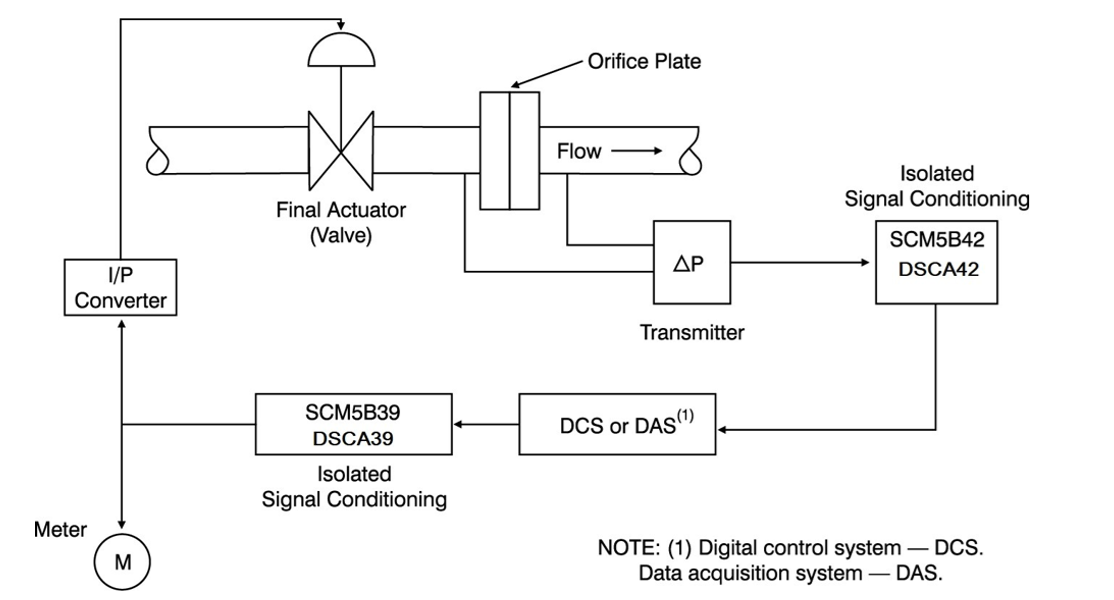 Figure 1: Example of an industrial measurement and control loop using isolated signal conditioning. Source: Dataforth
Signal conditioning bridges the gap between the sensor and the control or data acquisition system
Proper signal conditioning helps ensure that measurement signals are accurate, stable and reliable. It can minimize noise and distortion while preparing signals for processing, monitoring and control. Without effective signal conditioning, even a high-quality sensor can deliver data that compromises system performance.
For engineers designing, troubleshooting or upgrading industrial measurement systems, understanding signal conditioning is essential. The measurement chain shown above illustrates how a process measurement can move from a transmitter through isolated signal conditioning to a digital control or data acquisition system, then back through the control loop.
What is being measured?
· Physical measurements: pressure, temperature, flow, force, vibration, mass and density.
· Compositional measurements: conductivity, pH and chemical analysis.
Learn more about signal conditioning
Download Dataforth’s free handbook, Industrial Signal Conditioning: A Tutorial, to learn more about the fundamentals and practical considerations involved in achieving reliable, high-quality measurement signals.