New automated gene sequencing system expedites disease detection and tracking
Marie Donlon | August 05, 2026A fully automated process that promises to accelerate the preparation of bacterial samples for genetic sequencing has been developed by a team of biomedical engineers at Brown University, along with help from the FDA and Revvity.
According to its developers, the new process, called Pathogen2Read, streamlines genetic sequencing, enabling smaller labs to contribute more easily to U.S. Food and Drug Administration (FDA) and the Centers for Disease Control and Prevention (CDC) outbreak-monitoring networks and expediting responses to foodborne illness outbreaks.
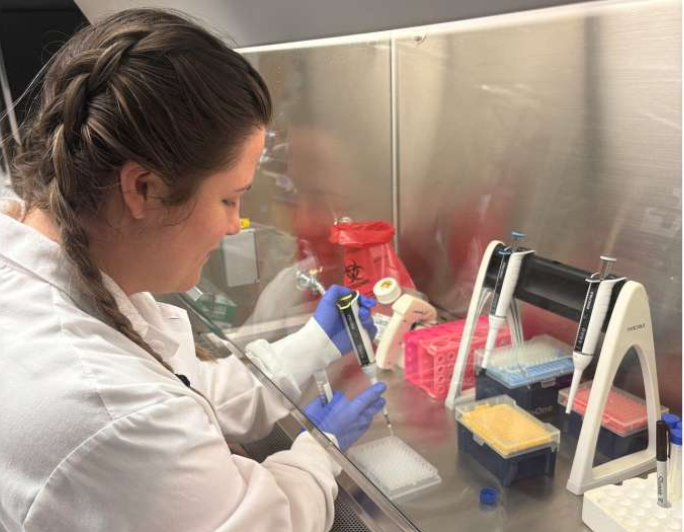 Source: Sarah Planchak
"Next-generation sequencing has become a staple in outbreak detection and prevention," the team explained. "But sample preparation involves labor-intensive manual preparation and culture isolation, which can delay real-time outbreak responses. Our laboratory has developed what is, to our knowledge, the first fully automated scientific method that bypasses these limitations."
As such, the Pathogen2Read process was built to incorporate assay preparation steps, custom software and a specially prepared enzyme cocktail that allows for a desktop liquid-handling machine to handle all the steps of DNA sample prep — lysis, extraction and library preparation — autonomously.
This new process enabled researchers to compress the preparation time from almost 10 hours to just under 45 minutes. As soon as a human operator loads the raw samples and reagents onto a single plate, the system will automatically handle the remaining steps over a six-hour run, creating sequencer-ready DNA libraries, the quality of which is critical, especially when looking for mutations in a bacterial strain.
"Because you're looking for small mutations that may be involved in drug resistance, for example, it's easy to miss them if you're not capturing all the sequences," the team added. "So the quality of the sample preparation is critically important."
Crucial to the new process, the team explained, is the enzyme cocktail, which rapidly breaks open different types of bacteria. In the lab, the team found that this new enzyme cocktail improved extraction of hard-to-break gram-positive bacterial DNA by roughly 2.5 times while also cutting processing time from 16 hours to just 30 minutes.
An article detailing the process, “Pathogen to read: a rapid, automated workflow for public health-ready microbial sequencing,” appears in the journal BMC Genomics.