90-second process upcycles wet coffee grounds into solid fuel
Marie Donlon | July 15, 2026A technology that converts wet spent coffee grounds into biochar in just 90 seconds without the need for drying or oil removal has been developed by team of researchers at the Korea Institute of Geoscience and Mineral Resources (KIGAM).
In what may prove an energy-efficient path for converting high-moisture organic waste into valuable fuel and carbon materials, the team devised a way to harness the energy potential of spent coffee grounds.
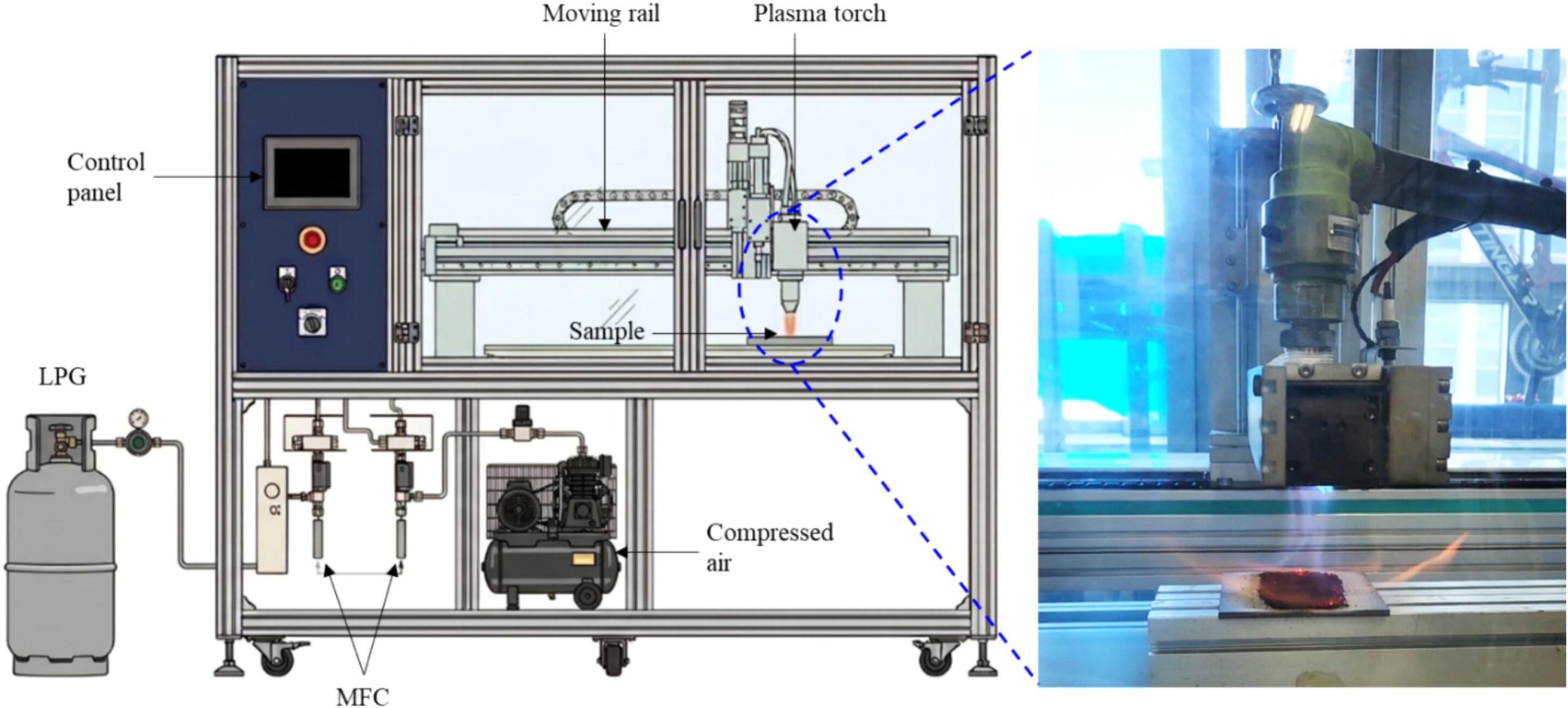 Source: Chemical Engineering Journal (2026). DOI: 10.1016/j.cej.2026.176452
The team explained that while spent coffee grounds have always possessed real energy potential, their high moisture content poses a barrier. Specifically, converting the grounds into fuel or carbon products generally requires energy-intensive pre-drying, which makes large-scale resource recovery impractical, economically speaking.
As such, the KIGAM team developed Flame Plasma Pyrolysis (FPP), which is a process that treats biomass containing roughly 55% moisture under atmospheric-pressure plasma conditions.
According to the team, the system produces plasma flames at temperatures of around 800° C to 900° C via the combustion of liquefied petroleum gas (LPG) and compressed air. This process, which is unlike conventional pyrolysis technologies, eliminates the need for any pre-drying treatment.
Intense heat instantly vaporizes moisture within biomass particles, producing tiny "popcorn effect" explosions that boost carbonization and create a highly porous structure. The moisture also serves as a steam-activation agent, accelerating reactions and enhancing the quality of the final product.
During trials, the team achieved complete conversion within 90 seconds, and a mass reduction of 83.3%.
Meanwhile, the resulting biochar demonstrated a heating value of 29.0 MJ/kg, which was roughly 33% higher than the original coffee grounds — comparable to that of anthracite coal.
Further, the new biochar experienced an almost threefold increase in fixed carbon content — from 15.6% to 46.2% — as well as complete removal of sulfur compounds, thereby preventing sulfur oxide emissions during combustion.
Likewise, there was an increase in specific surface area from 1.5 to 115.4 m2/g, thus suggesting its potential appropriateness for use as an activated carbon precursor or adsorption material.
Importantly, there was minimal formation of secondary pollutants such as smoke and tar with the new material.
Altogether, these characteristics make the biochar appropriate not only as a renewable solid fuel, but also as a high-value carbon material for environmental and industrial applications.
The team noted that the new process offers substantial advantages in both processing speed and energy efficiency versus hydrothermal carbonization (HTC), which generally requires one to six hours. Specifically, the FPP process is 40 to 240 times faster. Additionally, it also cuts treatment time by more than 20-fold versus torrefaction, which typically requires at least half an hour.
The system relies on combustion-generated plasma instead of electricity-intensive plasma devices, thereby reducing energy consumption while maintaining performance. A significant advantage is its ability to process wet waste without pre-drying, which lowers costs and environmental impact. The technology could also be applied to other high-moisture wastes, such as food waste, sewage sludge and agricultural residues, and its compact, fast-processing design makes it appropriate for decentralized waste-to-energy facilities. Researchers say the approach could help turn organic waste into valuable energy resources and support carbon-neutral waste management.
An article detailing the process, “Rapid conversion of wet spent coffee grounds into high-calorific biochar via drying-free flame plasma pyrolysis for process intensification,” appears in the journal Chemical Engineering Journal.