Inspired by armadillos: New soft robotic shell becomes rock-solid on demand
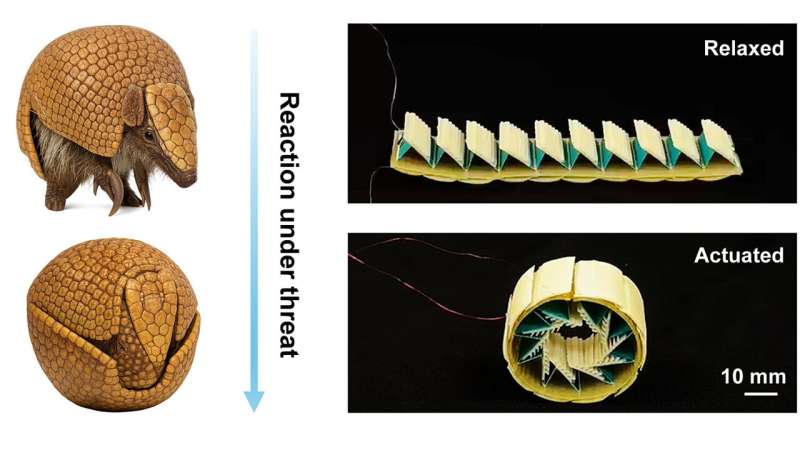
Marie Donlon | June 01, 2026Taking inspiration from the armadillo, a team of researchers from North Carolina State University has created a protective structure that reportedly responds to external threats by curling into a ball to protect electronic devices or other payloads.
According to its developers, the structure automatically responds when it detects strain and it can be tuned to respond to anything that ranges from a delicate touch to a significant impact.
 Source: Jianyu Zhou, NC State University
"There has been a great deal of growth in the fields of soft robotics and flexible electronics, but those devices are often also fragile," the team explained. "Our goal was to develop a solution that allows these fragile technologies to function but protects them when necessary."
"In its relaxed state, the structure we've developed is fairly flexible, but it can be activated to curve into a rigid external structure," the team noted. "We could see this technology being used to protect many types of objects — essentially anything it is capable of curving around."
The structure, dubbed robo-armadillo, is a morpho-interlocking protective module (MIPM) that features three layers: an exoskeleton outer layer that includes a series of segmented, curved scales made from a 3D-printed resin; a middle sensing and actuation layer that consists of a liquid-crystal elastomer (LCE) that contracts when heated, a strain sensor composed of elastic polymer embedded with silver nanowires, kapton tape that expands when heated and conductive fabric that functions as a heater layer; and an endoskeleton layer that is comprised of heavy-duty paper folded into a network of ridges that holds a row of rigid polymer segmental scales in place.
The team explained that when the strain sensor detected a touch or an impact, it signaled a control unit, which then sent power to heat up the heater layer, thereby causing the LCE layer to contract and the kapton tape layer to expand. This caused the entire structure to curve. The end result is that the MIPM structure curls into a protective circle with the exoskeleton facing out.
When the layers curved into a circle, the segmental scales in the MIPM's endoskeleton locked into each other, which created a strong internal 'skeleton' that fortified the structure.
During trials of the structure, the team discovered that MIPM worked as desired with the sensor layer detecting increased strain and then transforming into a protective shell. The team also discovered that by increasing the number of segmental scales in the endoskeleton, the structure's internal rigidity and strength were significantly improved — for example, 10 segmental scales withstood roughly 10 newtons of force.
An article detailing the work, “Armadillo-inspired active morphing skeletons for soft machines,” appears in the journal Science Advances.