“Living plastic” material activates and self-destructs on demand
Marie Donlon | May 05, 2026A team of researchers from the Chinese Academy of Sciences has created plastic-like products — dubbed living plastics — capable of self-destructing on command.
According to the developers, these materials incorporate activatable, plastic-degrading microbes alongside polymers. In the lab, the team used two bacterial strains that worked in concert and completely broke down the material within just six days, all without creating microplastics.
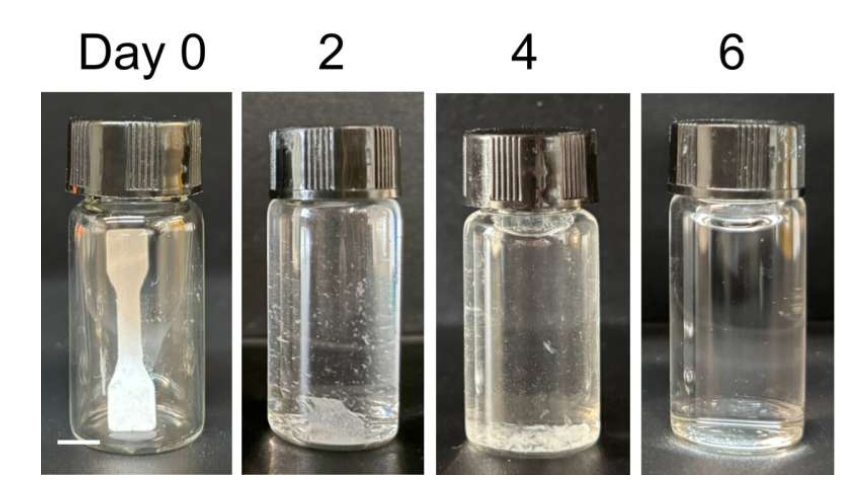 A living plastic with a pair of cooperative, plastic-destroying enzymes degraded the material completely within six days. Source: Adapted from ACS Applied Polymer Materials 2026, DOI: 10.1021/acsapm.5c04611
To develop these living plastics, the team first asked how they could build degradation directly into the material's life cycle.
They explained that many microbes can break long polymeric chains into smaller chains using enzymes, and because plastics are polymers, such enzymes — or the microbes that produce them — could be integrated into the living plastics.
"By embedding these microbes, plastics could effectively 'come alive' and self-destruct on command, turning durability from a problem into a programmable feature," the team noted.
Although earlier attempts relied mostly on a single enzyme, the team sought to improve the destruction efficiency. To accomplish this, the team engineered Bacillus subtilis to create two cooperative, polymer-degrading enzymes — one of those enzymes functioned as a random chopper, cutting the long polymer chains into smaller pieces, while the other enzyme slowly chewed those pieces into their monomer building units from each end.
The dormant spore form of B. subtilis was then mixed with polycaprolactone (which is a polymer commonly used in 3D printing and some surgical sutures) to protect the microbes before they were eventually needed. The final living plastic product demonstrated mechanical properties much like those of plain polycaprolactone films. Yet, once a nutrient broth at 122◦ F (50◦ C) was added, the spores activated and then broke the plastic all the way down to its base building blocks following just six days. The process was reportedly so efficient, it even prevented microplastic particles from being formed during the degradation process.
In the lab, the team created a proof-of-concept wearable plastic electrode out of the living plastic and it degraded completely within two weeks.
An article detailing the living plastic, “Degradable Living Plastics Programmed by Engineered Microbial Consortia,” appears in the journal ACS Applied Polymer Materials.