
A new spin on fuel for fusion
S. Himmelstein | May 12, 2026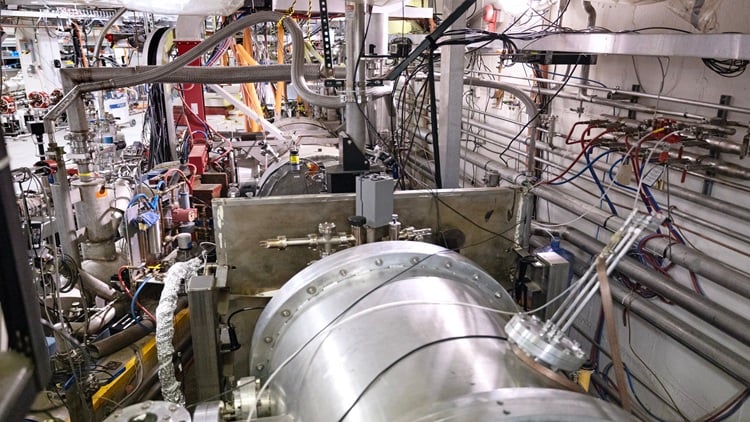 Source: U.S. Department of Energy’s Thomas Jefferson National Accelerator Facility/Aileen Devlin
An advanced concept for the treatment of nuclear fuel offers a path to significantly increase the energy output rate of fusion reactions and enable smaller, less expensive devices with relaxed ignition requirements. The spin polarization process under development at the U.S. Department of Energy’s Thomas Jefferson National Accelerator Facility would provide a superabundant source of electricity.
The project underway at the DIII-D National Fusion Facility’s tokamak focuses on the use of deuterium and helium-3, a helium isotope that has the same spin dynamics as tritium with nearly identical mass and selected as an alternative due to tritium’s scarcity, instability and associated hazards. The DIII-D tokamak research device uses magnetic fields to confine plasma within its donut-shaped volume.
Researchers from the University of Virginia, U.S. Oak Ridge National Laboratory, the University of California- Irvine and the DIII-D National Fusion Facility will test whether the isotopes’ polarization can survive long enough, as theory predicts, in a magnetically confined, 100-million-degree plasma. If so, it promises to increase the likelihood of a fusion reaction by 50%, boosting the energy output of the system by up to 80%.
A microwave generator system will deliver radio frequency waves that will help polarize pellets for the spin-polarized fusion fuel project. Polarized fuel pellets will be transferred to a pellet injector, which will use compressed gas to send the pellets to the DIII-D tokamak at high speeds. Cryogenics and magnetic coils will maintain the particles’ polarized spin during the milliseconds-long transport. Specialized detectors will then measure fusion products and provide a definitive test of fuel polarization’s survival in a 100-million-kelvin plasma.



