How often should you calibrate your pH sensor?
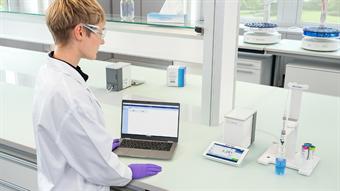
Parul Chhaparia, courtesy of Mettler Toledo | April 21, 2026 Accurate pH calibration relies on precise buffer solutions and proper temperature adjustment, whether automatically or manually entered. Source: Mettler Toledo
In any analytical environment, whether in industry or the laboratory, precision isn’t only important to have, it’s fundamental. The accuracy of your measurement results largely depends on the reliability of your pH sensor, which makes regular calibration essential. But the question arises, how often should you calibrate your sensor?
Due to the chemical nature of the sensing electrode, every pH probe experiences sensor drift over time. This drift is an inevitable shift from accurate readings that can compromise your data quality and, ultimately, affect product quality. Therefore, determining the correct calibration frequency becomes crucial for operational efficiency and data integrity.
In this article, we will discuss the importance of calibration, the recommended frequency and best practices to keep a pH sensor performing optimally.
Why calibration is important
A pH sensor, also called a pH electrode, measures the hydrogen ion concentration in a solution. However, like any measuring device, it can drift over time due to factors like aging, contamination and changes in the electrode’s properties. Calibration adjusts the sensor’s readings to align with known standard values, ensuring precise measurements. Buffers are essential during calibration because they provide stable pH values that help accurately adjust the sensor.
The pH sensor’s response is characterized by two main parameters: the slope and the offset. The theoretical relationship is described by the Nernst equation, which relates the electrode potential (in millivolts) to the pH level of the solution. During calibration, these parameters are adjusted to match the true values. The slope indicates how the sensor’s voltage changes with pH, while the offset is the sensor’s voltage at pH 7, which ideally should be zero.
 Slope and offset for a pH electrode. Source: Mettler Toledo
The calibration is necessary to adjust the slope and offset of an electrode to their true values for the measuring system in question.
Recommended frequency of calibration
It is generally recommended to calibrate your pH sensor at least once a day before starting any measurements. This daily calibration ensures that any drift or changes in the sensor’s behavior are accounted for, providing accurate and consistent results throughout the day.
For optimal accuracy, a two-point calibration is advisable. This means using two buffer solutions with known pH values to set both the zero point (offset) and the slope of the electrode. When measurements cover a wide range of pH values, it is better to perform a three-point calibration or even more, with some pH meters supporting up to five calibration points. This multi-point calibration helps in creating a more reliable calibration curve, reducing errors across the pH spectrum. It is important to note that one should only measure samples within the chosen region of calibration.
Choosing buffer solutions for calibration
Calibration buffers are special solutions with precisely known pH values. The choice of buffer solutions and their temperature dependency are crucial for accurate calibration. Many pH meters come pre-loaded with buffer tables that consider different buffer manufacturers and temperature corrections.
If your pH meter does not have an internal or external temperature sensor, it is important to calibrate and measure the sample at the same temperature. Manually inputting the temperature helps the meter adjust for any temperature effects on the buffer’s pH.
Proper handling of buffer solutions
To maintain the accuracy of buffer solutions over time, follow these handling guidelines:
- Mark the date of first use on the buffer bottle.
- Keep the buffer bottles tightly sealed and use any decanted solution immediately.
- Never return used buffer solution to the original bottle or mix buffers from different manufacturers.
- Avoid contamination by ensuring the bottle remains sealed when not in use.
- Store buffer solutions at ambient temperature, away from direct sunlight.
- Do not calibrate the electrode directly in the original buffer bottle; use a clean container.
- Replace buffer solutions once they reach their expiry date or if contamination is suspected.
When to recalibrate
Besides daily calibration, always recalibrate your pH sensor after:
- Cleaning the electrode.
- Performing electrode maintenance or regeneration.
- Long-term storage of the electrode.
Consistent calibration practice not only ensures reliable data but also extends the life and performance of your pH sensor.
To explore detailed pH measurement techniques, you can download our pH theory guide. For best practices, download our interactive guide on how to handle buffer solutions.
To contact the author of this article, email pHmatters@mt.com