Fabric that cleans itself could make detergent obsolete
Marie Donlon | March 25, 2026A team of researchers from China’s Southeast University and Jilin University has developed a self-cleaning fabric coating that promises to keep traditional laundry detergents from contaminating the environment.
According to its developers, the coating was developed by spraying a fabric with two polymers — poly(diallyldimethylammonium chloride) (PDADMAC) and poly(vinylsulfonic acid) (PVS) — which together created a dense hydration layer that lets dirt and microbes be washed away with just water.
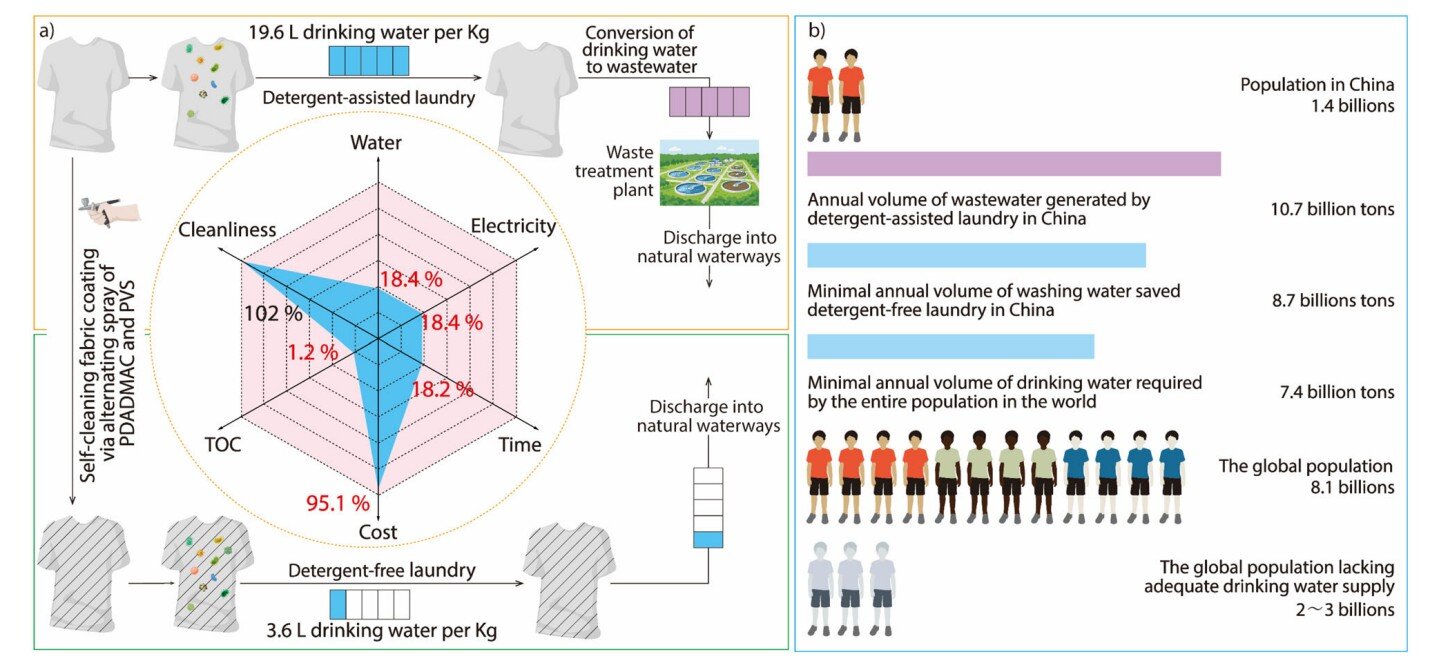 An environmentally and biologically friendly, self-cleaning fabric coating for detergent-free, water-saving laundry. Source: Communications Chemistry (2026). DOI: 10.1038/s42004-026-01942-7
Specifically, the team used a spray-assisted deposition method, switching back and forth between spraying PDADMAC and PVS. This approach compelled the molecules to tangle and bind together in a stable way that previous techniques could not achieve.
The team explained that the ultra-high density of sulfonate groups from PVS created the continuous hydration layer, forming a water shield that functions under all lighting conditions, even in the dark.
When trialed, the coating reportedly maintained its effectiveness for more than 100 wash cycles. Further, laundry was completed faster and water and electricity consumption were reduced by roughly 82%.
The team also determined that the coating did not lose its effectiveness once it dried, unlike other coatings. This is because the spraying process created a kinetically trapped structure, wherein the molecules are locked in place. Consequently, the fabric remains both water-attracting and self-cleaning.
The coating also works on both hydrophobic synthetic fibers and hydrophilic cotton textiles, removing food stains, oily residues, bacteria and fungi with just a rinse with tap water.
An article detailing the coating, “A versatile self-cleaning fabric coating as a detergent-free laundry product,” appears in the journal Communications Chemistry.