Recyclable Plastic Stronger Than ABS Developed
By Engineering360 News Desk | April 12, 2016Researchers at the Department of Energy’s Oak Ridge National Laboratory (ORNL) have developed a recyclable thermoplastic that is significantly stronger than ABS (acrylonitrile, butadiene and styrene) by replacing styrene with lignin, a brittle, rigid polymer that, with cellulose, forms the woody cell walls of plants. The material, which its inventors call "ABL," could prove to be a more sustainable alternative for use in ventilation pipes, protective headgear, kitchen appliances and many other consumer products that are currently fabricated from ABS.
“The new ORNL thermoplastic has better performance than commodity plastics like ABS,” says Amit Naskar, of ORNL’s Materials Science and Technology Division, who together with co-inventor Chau Tran has filed a patent application for the process to make the new material. “We can call it a green product because 50% of its content is renewable, and technology to enable its commercial exploitation would reduce the need for petrochemicals,” he adds.
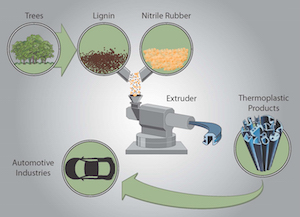 Lignin and nitrile rubber are heated, mixed and extruded to yield a strong thermoplastic. Image credit: ORNL/Mark Robbins.To produce an energy-efficient method of synthesizing and extruding high-performance thermoplastic elastomers based on lignin, the ORNL team needed to determine which types of lignin had both the thermal and melt stability to make them good candidates as a thermoplastic feedstock. The researchers then needed to "toughen” the lignin by chemically combining soft matter with it to make it more ductile.
In a heated chamber with two rotors, the researchers “kneaded” a molten mix of equal parts powdered lignin and nitrile rubber. During mixing, lignin agglomerates broke into interpenetrating layers, or sheets, of 10 to 200 nanometers in thickness that dispersed well in, and interacted with, the rubber. The product that resulted had properties of neither lignin nor rubber, but something in between, with a combination of lignin’s stiffness and nitrile rubber’s elasticity.
By altering the acrylonitrile amounts in the soft matrix, the researchers hoped to improve the material’s mechanical properties further. They tried 33%, 41% and 51% acrylonitrile and found that 41% gave the optimal balance between toughness and stiffness.
Next, the researchers experimented to determine whether controlling the processing conditions could improve the performance of the polymer alloy. For example, 33% acrylonitrile content produced a material that was stretchy but not strong, behaving more like rubber than plastic. At higher proportions of acrylonitrile, the researchers saw the materials strengthen because of the efficient interaction between the components. They also wanted to know at what temperature the components should be mixed to optimize the material properties. They found heating components to between 140 and 160 degrees Celsius formed the desired hybrid phase.
Future studies will explore different feedstocks, particularly those from biorefineries, and correlations among processing conditions, material structure and performance. Investigations are also planned to study the performance of ORNL’s new thermoplastic in carbon fiber-reinforced composites.