Mapping Technologies for Autonomous Cars Require Standardization
By Engineering360 News Desk | April 12, 2016Connected vehicles that upload data to the cloud will enable the development of increasingly accurate, real-time maps—a necessary precursor to truly autonomous driving. But standards have yet to be developed that would allow for interaction among competing map technologies.
“Crowdsourcing is crucial,” says Dominique Bonte, managing director and vice president at ABI Research, a technology market intelligence company. “As connected vehicles include more low-cost, high-resolution sensors, cars will capture and upload this data to a central, cloud-based repository so that automotive companies, such as HERE, can crowdsource the information to build highly accurate, real-time precision maps."
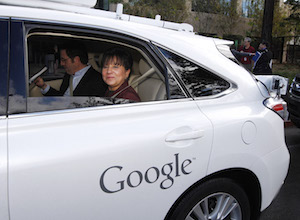 Department of Commerce Secretary Penny Pritzker rides in an autonomous vehicle. Image credit: DOC. These dynamic 3D maps will provide a complementary data set to vehicles' ADAS sensors for an overall smoother driving experience. Whereas sensors provide real-time visibility on a vehicle’s immediate vicinity for last-minute obstacle detection and collision avoidance, maps extend this visibility to allow vehicles to anticipate those situations long before the sensors would even have to detect them.
However, ABI Research contends that a big challenge for the new mapping paradigm is the lack of standards, coupled with high levels of fragmentation in the automotive industry. Despite HERE’s efforts to assemble the industry around its Sensor Integration Standard for real-time map attributes, many other players, like ADAS vendor Mobileye, are also vying to play a role in map data crowdsourcing and proposing and/or imposing their own proprietary approaches.
And the battle for controlling crowdsourced driverless HD map technology is heating up. Daimler, joint owner of HERE with BMW and Audi, confirmed talks with Amazon and Microsoft to join the consortium. For their part, Mobileye has signed agreements with GM, VW and Nissan to use its Road Experience Management mapping platform. NVIDIA, meanwhile, has announced its new HD mapping approach based on its DRIVE™ PX machine-vision hardware platform. Toyota has also announced its own mapping platform, working with mapping vendor Zenrin, of Japan.
“The industry needs to set standards, if only for the fact that standards readily allow vehicles to exchange real-time map attributes between each other,” concludes Bonte. “In the early stages, new players introducing their own solutions might actually fuel innovation and accelerate adoption of crowdsourced map technology. But in the long term, economies of scale and a maturing market environment will require the adoption of standards and open-platform approaches.”