Piercing the plasma sheath during spacecraft re-entry
Andy Tomaswick | March 02, 2026
Spacecraft re-entering the atmosphere famously run into a fiery engineering hurdle: the massive fireball that forms around them when they hit the atmosphere going upwards of Mach 15.
Much of spacecraft engineering is centered on mitigating the risks that come along with that re-entry process, but there’s one particular aspect of it that has remained a challenge for aerospace engineers for decades: the communications blackout. All communication with the spacecraft is lost for up to 10 minutes during the most critical part of the flight. Plenty of solutions have been put forward, but none have yet truly been able to solve the issue.
A paper from researchers at the Harbin Institute of Technology and Imperial College London has a potential solution to this long-standing problem: manipulating the plasma sheath itself to use it as a medium for the radio waves it would otherwise block.
Plasma problem
Craft re-entry creates friction and pressure, which heats ions in the air surrounding the re-entering spacecraft and creates a dense layer of ionized gas, known as a plasma sheath, directly around the spacecraft itself.
Plasma is notoriously opaque to radio signals, and there’s no exception for these spacecraft. The plasma sheath itself acts as a negative-refractive-index of standard radio frequencies, essentially blocking communications by standard means with the spacecraft until the plasma cools down enough to re-establish them.
Engineers have spent decades working on this problem and they’ve come up with two potential solutions: material selection and high frequency systems. Material selection solutions ranged from intentionally injecting material into the plasma sheath to either cool it down enough so radio can pass through, or to clear a pathway through the sheath itself using a strong magnetic field that would allow radio waves to pass through unscathed. Neither worked particularly well, and both were energy and weight intensive, which is a non-starter for many aerospace applications.
In theory, higher frequency signals, such as Ka-Band or Terahertz, would be able to pass through the sheath unscathed without any problem on their own. However, it's not just plasma surrounding these spacecraft, it's also the burnt parts of the spacecraft itself. Dust and debris coming from the spacecraft’s ablative heat shield impedes these high frequency signals, making their signal connections tenuous.
Engineers are in obvious need of a better solution to make sure that the astronauts in the spacecraft can communicate with ground support.
Can crystals help pierce the plasma sheath?
A plasma photonic crystal might just be the answer. These crystals are typically used in optical computing and signal processing applications and are made by arranging a periodic structure of plasma and other dielectric materials to control the propagation of magnetic waves. It would be a good fit for the communication blackout problem, especially since it is caused by plasma in the first place.
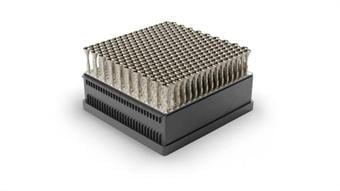
In their paper, the authors constructed a crystal by arranging small alumina rods in a repeating lattice pattern. The plasma space between each rod was small enough for a signal to hop from one rod to another without being lost in the plasma soup. Eventually the signal would make it all the way to the spacecraft itself, allowing for communication through a series of small plasma-filled jumps rather than trying to make it all the way through, or directly manipulating the plasma itself.
Particles from the burning spacecraft itself could still prove a problem though. To solve that issue, the researchers configured two separate rod patterns in a particular order, essentially creating an electromagnetic waveguide down the middle between the two of patterns. When impurities entered the waveguide, they then wouldn’t affect the resultant signal as much as it would be able to pass cleanly down the channel.
This is all well and good in theory, but how does it behave in practice? The researchers took on that challenge and built a reasonable replica of the spacecraft’s environment in a lab. They pumped in argon gas and used an electrical current to zap it into plasma. They placed the alumina rods between two metal plates, filled the plates with plasma and beamed microwaves through it.
The experiment worked extremely well, as one might expect in laboratory conditions. The signals traveled down the waveguide, unobstructed by any debris the experiments put in their way. No data was lost as the signals were passed from alumina rod to alumina rod, allowing direct communication from one side of the plasma sheath to another.
But perhaps the most interesting feature of the test was the creation of a Dirac-like cone. By adjusting the size of the rods and density of the plasma, the researchers were able to force the entire crystal to act like it was simply a pass through with no attenuation at all. Normally, radio waves are represented by sine waves that are commonly taught in physics classrooms throughout the world. But in a “zero-index” zone like that of the crystal in the experiment, the waves stop acting like a traveling wave and more like a concerted whole.
The whole electromagnetic field in a Dirac cone pulses up and down at the same time. Essentially it acts as a zero-refractive index material, something almost unheard of in electromagnetic theory. That’s part of the magic that allows signals inside the crystal to ignore the physical impurities introduced, as the signal strength in such a state is significantly higher than when operating normally.
Future outlook
Getting this setup to operate in a lab is a far cry from getting it to operate on an actual spacecraft undergoing re-entry, though. Some immediate concerns that come to mind are whether air plasma would have the same properties as the argon plasma used in the experiment, would the structure itself be able to withstand the heat of re-entry, and how would it handle the plasma that would form outside of the metal plate that hold the alumina rods together?
But those are questions for another experiment. For now, this is a step toward solving one of the most intractable, and in some ways terrifying, problems facing a potential future human egress into space. There’s plenty more work to do on ruggedizing this tech, along with many others, for the struggles of space flight. But surely the seeming magic of plasma photonic crystals has many more use cases to try out.