High-moisture extrusion redefines food processing
Jody Dascalu | March 02, 2026High-moisture extrusion is widely used for producing fibrous, meat-like structures from plant protein ingredients at industrial scale. By combining thermomechanical treatment with controlled cooling, the process forms aligned protein networks that resemble the texture of whole-cut meat products and can be consumed without rehydration.
Although the process is well established commercially, consistent texture formation remains difficult to achieve. Similar formulations processed under comparable conditions can produce markedly different structural outcomes. This sensitivity reflects the coupled influence of temperature profiles, flow behavior, and material properties during extrusion and solidification, factors that are not directly observable during operation and are often adjusted empirically.
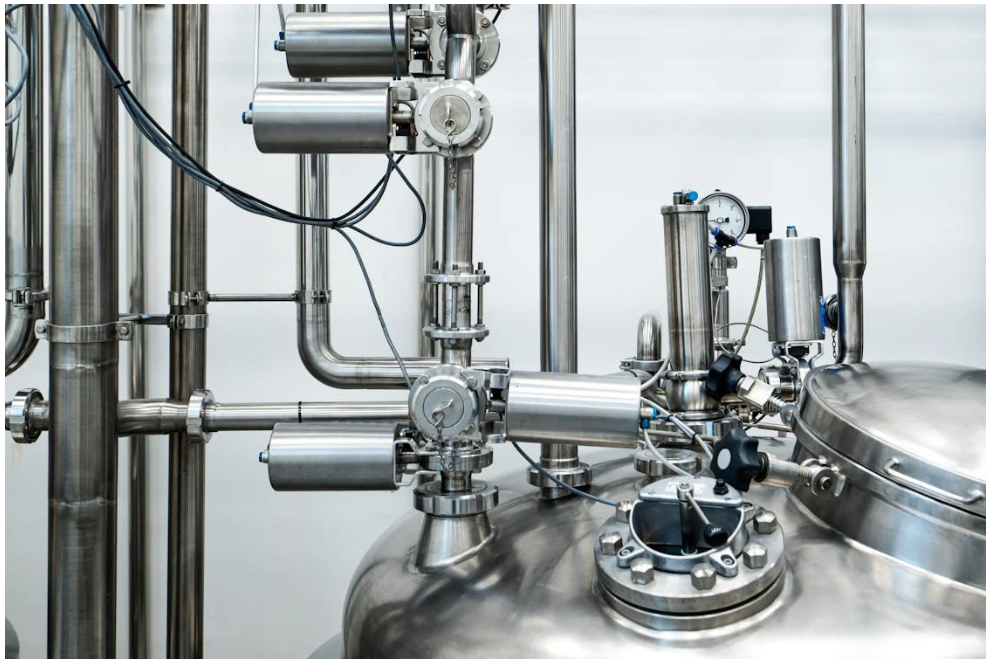 Stainless steel processing equipment used in controlled industrial manufacturing. Source: Polcarpo Brito/Pexels
Current research and industrial development focus on improving control over these interactions. Advances in cooling-die design, process modeling and formulation strategies are helping to reduce variability and expand the range of usable ingredients. These efforts aim to move high-moisture extrusion toward more predictable operation while improving energy efficiency and product consistency in food processing applications.
Mechanisms of structure formation
Fibrous structure in high-moisture extrusion develops during cooling under flow. While thermomechanical treatment in the extruder barrel prepares the material, macroscopic texture emerges as the protein melt is shaped and solidified in the cooling die.
As the melt enters the cooling die, heat is removed from the walls toward the center, creating strong radial temperature and viscosity gradients. Material near the die walls stiffens first and moves more slowly, while the hotter core remains fluid and flows faster. These velocity differences generate shear that aligns unfolded protein chains along the direction of flow.
As cooling continues, solidification advances inward and the flow progressively shifts toward plug-like behavior. Once the protein matrix has sufficiently solidified, molecular mobility decreases and the aligned structure is preserved. The layered and V-shaped patterns observed in cross-sections of high-moisture extrudates reflect these coupled flow and solidification processes within the cooling die.
Sources of variability in current systems
Despite widespread commercial adoption, high-moisture extrusion remains fundamentally constrained by its sensitivity to coupled thermal, rheological and compositional effects. As a result, consistency in high-moisture extrusion is limited by both material and process variability.
Plant protein ingredients differ across batches in composition, solubility and particle characteristics, which can shift flow behavior and structure formation even when operating conditions are unchanged. In many cases, formulation differences have a greater effect on texture than moderate adjustments to barrel temperature.
Die design and cooling behavior introduce additional sensitivity. Cooling rate depends on die geometry and heat transfer conditions, and uneven solidification can lead to heterogeneous texture across the product cross-section. Narrow dies promote rapid alignment but increase energy demand, while wider dies improve throughput at the risk of under-cooled cores.
Many production lines compensate for these effects through empirical tuning. Adjustments to feed rate, screw speed and cooling conditions are typically based on operator experience rather than predictive control, which limits repeatability when ingredients or ambient conditions change.
Protein interactions and crosslinking behavior
The texture of high-moisture extrudates is stabilized by molecular interactions that form as the protein melt cools and solidifies. Hydrogen bonding and hydrophobic interactions contribute to early network formation during extrusion, while disulfide bonds formed through thiol–disulfide exchange provide the primary covalent crosslinks that preserve fibrous structure after cooling.
Studies of pea protein systems show that disulfide-mediated crosslinking accounts for a large fraction of network strength and increases when additional protein sources are present. Hybrid formulations illustrate this effect clearly. Myofibrillar proteins released from cultivated beef cells introduce additional reactive thiols, enabling crosslinking with plant globulins during solidification.
As the availability of sulfur-containing amino acids increases, disulfide bond formation becomes more extensive, corresponding with higher hardness, resilience and cohesiveness in texture measurements. These effects highlight how formulation choices influence intermolecular bonding and final mechanical properties without altering extrusion hardware.
Approaches in process control and formulation
Modeling of flow and heat transfer in cooling dies has improved significantly. Numerical simulations can now estimate temperature, velocity and viscosity profiles for specific die geometries and operating conditions. Key rheological transitions, including the shift from shear flow to plug flow and the onset of wall slip, are inferred through inverse modeling that aligns simulated pressure and flow behavior with experimental data.
These models support systematic exploration of operating conditions. Instead of relying solely on trial-and-error adjustment, manufacturers can identify ranges that balance energy input, throughput and texture outcomes before physical testing. This approach reduces the number of pilot trials required and improves repeatability when scaling or changing formulations.
Formulation development offers a complementary route to improved consistency. Blending proteins with different functional properties can adjust melt behavior and expand processing windows. Plant protein blends alter viscosity and network formation in ways that single-protein systems cannot achieve alone. Hybrid formulations that include small amounts of animal-derived proteins further enhance water and oil retention, improving texture and processing stability without requiring changes to extrusion equipment.
Sensory and functional quality considerations
Sensory quality remains a limiting factor for plant-based extrudates. Pea protein commonly produces beany off-flavors and bitterness associated with volatile compounds and antinutritional components, which reduce consumer acceptance even when texture is acceptable. These sensory effects are influenced by both formulation and processing conditions and often constrain how aggressively extrusion parameters can be adjusted.
Hybrid formulations help mitigate these limitations while also improving functional performance. Denser protein networks formed with small additions of animal-derived proteins retain volatile compounds more effectively and reduce bitterness and astringency. At the same time, process-induced color development follows predictable thermal patterns driven by Maillard reactions, with higher temperatures and protein levels increasing browning. Managing flavor, texture and color together is therefore necessary to achieve acceptable sensory outcomes without compromising processing efficiency.
Practical implications for future products
Advances in process modeling and formulation design support more consistent and scalable production of plant-based and hybrid meat analogues. Predictive tools reduce reliance on empirical tuning by linking die conditions, cooling behavior and formulation choices to texture outcomes. While pilot validation remains necessary, the overall development effort can be reduced as operating windows become better defined.
Improved control also enables gains in energy efficiency and ingredient flexibility. Adjusting melt behavior through formulation allows target textures to be achieved with lower mechanical input, reducing cost and environmental impact. Broader formulation options expand the range of usable protein sources without requiring new equipment. From a manufacturing perspective, modest changes in process understanding and composition can deliver meaningful improvements in performance and robustness.