Lightweight sensors could de-ice planes faster
Marie Donlon | February 10, 2026A team of researchers at the University of Toronto has developed an ice detection system that promises to expedite the de-icing process for aircraft and other aerospace vehicles, helping to prevent flight delays and reducing the use of current de-icing solutions, which tend to be toxic to wildlife.
To develop the system, the team used a triboelectric nanogenerator (TENG) sensor that is capable of detecting ice forming, melting and detaching on surfaces, providing this information in real time but using very little energy.
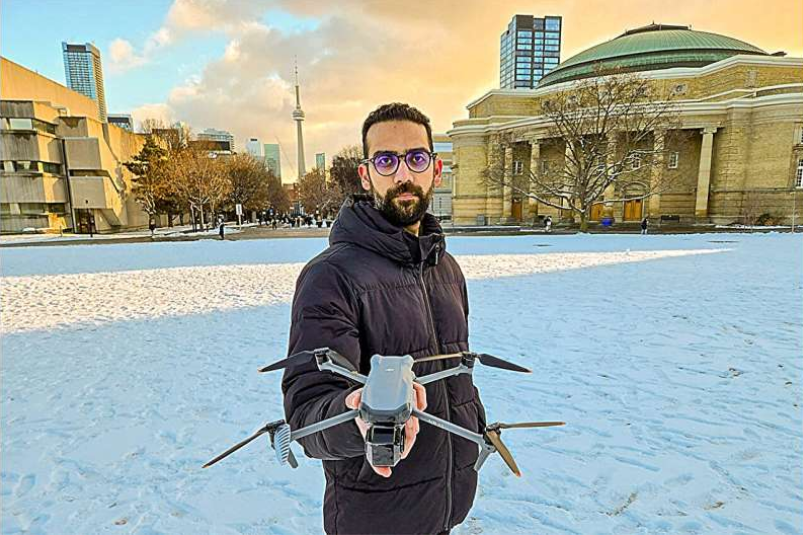 Kamran Alasvand Zarasvand aims to make aerospace vehicles safer in icy weather. Source: Behrooz Khatir and Mohammad Soltani
"To the best of our knowledge, this is the first triboelectric ice-sensing system of its kind to be described in scientific literature," the researchers suggested. "The TENG sensor consists of two layers: a metal electrode and a thin dielectric plastic coating. When another material makes contact with this coating and then separates, they exchange a charge, producing a sharp electrical signal. The signal changes depending on what event occurs —so ice forming generates one signal pattern, while ice melting and detachment create a different one."
The team added that while the majority of existing ice-sensing systems are only capable of detecting ice at a localized point — which means that ice forming just centimeters away from the sensor could go unnoticed — the triboelectric sensor is reportedly much more reliable as it forms a continuous layer over the surface.
Because the sensor is composed of just two thin layers, it is extremely lightweight, easy to fabricate and can be applied to virtually any surface, even those surfaces with complex geometries like aircraft wings or wind turbine blades. Further, the sensor is also capable of detecting ice cracking or detaching from the surface.
"Based on the signal and temperature, we can also distinguish between types of precipitation, such as rime ice — a type that forms as planes fly through fog or clouds — or freezing rain, which is most dangerous for aircrafts," the team added. "Ice can damage vehicles like planes in a number of ways, leading to them being grounded or needing maintenance, and to increased costs and delays for travelers."
In addition to airplane wings and wind turbine blades, the sensor could also be applied to small drones, particularly those used for commercial inspections of power lines or delivering aid to remote regions, which need reliable ice detection to prevent crashes.
The new system reportedly responds in less than a millisecond, so drones, which are highly vulnerable to icing and will thus crash before much ice builds up, are able to land before icing can cause a crash.
Beyond de-icing, the team believes that the new sensor’s electrode layer could potentially function as an electrothermal de-icing system that melts ice as soon as it is detected.
As soon as the system detects ice formation, a heating function could potentially activate until the sensor confirms that the ice has melted.
The ice detection system is detailed in the article, “Triboelectric Nanogenerators Enable Multifunctional Ice Accretion, Melting, and Interfacial Fracture Detection,” which appears in the journal Advanced Materials