EPA Proposes Phaseout of Some Hydrofluorocarbons
By Engineering360 News Desk | April 07, 2016The U.S. Environmental Protection Agency (EPA) is proposing to ban the use of certain hydrofluorocarbons (HFCs) found in air-conditioning, refrigeration and fire suppression systems where more climate-friendly alternatives exist.
The proposal follows up on a November 2015 meeting of parties to the Montreal Protocol treaty in which countries agreed to work together in 2016 to amend the Protocol to reduce the production and consumption of harmful HFCs—a class of greenhouse gases that can be up to 10,000 times more potent than carbon dioxide. EPA estimates the emissions avoided from the proposed rule would amount to 11 million metric tons of carbon dioxide equivalent in 2030—equivalent to the emissions from the energy used by approximately one million homes for one year.
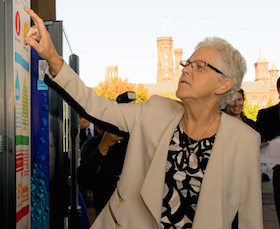 EPA Administrator Gina McCarthy tours a display of products using safer alternatives to HFCs. Image credit: EPA.As part of the proposal, EPA intends to expand the agency’s Significant New Alternatives Policy (SNAP) program list of climate-friendly alternatives. Under SNAP, EPA evaluates chemicals and technologies on an ongoing basis within a comparative risk framework.
EPA’s proposal includes:
· Listing as acceptable, subject to conditions to ensure safe use, propane and HFO-1234yf in specific end uses in the refrigeration and air-conditioning sector, and a new fire suppression agent for streaming and total flooding uses on aircraft;
· Listing as unacceptable certain flammable hydrocarbon (HC) refrigerants and HC blends for retrofitting existing residential central air-conditioning equipment designed for non-flammable refrigerants;
· Listing as unacceptable propylene and the HC blend R-443A in specific end uses in the refrigeration and air-conditioning sector; and
· Modifying the listing status for certain high-global-warming-potential alternatives for certain end uses in refrigeration and air-conditioning (e.g., chillers and household refrigerators), foam blowing and fire suppression and explosion protection sectors, and for methylene chloride for certain end uses in the foam-blowing sector.