Sensor-Outfitted UAV Allows Remote Methane Leak Detection
By Engineering360 News Desk | April 07, 2016Researchers have successfully flight-tested a miniature methane gas sensor developed by NASA's Jet Propulsion Laboratory (JPL), Pasadena, California, on a Vertical Take-off and Landing small unmanned aerial system (sUAS). The sensor, similar to one developed by JPL for use on Mars, enables detection of methane with much higher sensitivity than previously available for the industry in hand-carried or sUAS-deployable instruments.
The tests were conducted in central California at the Merced Vernal Pools and Grassland Reserve and funded by Pipeline Research Council International. The jointly conducted test of NASA's Open Path Laser Spectrometer (OPLS) sensor is the latest effort in a methane testing and demonstration program conducted on various platforms since 2014. The ability of the OPLS sensor to detect methane in parts per billion by volume could help the pipeline industry more accurately pinpoint small methane leaks.
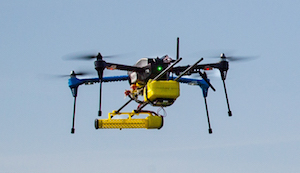 The sUAS' sensor enables gas detection with much higher sensitivity than previously available. Image credit: University of California, Merced. Researchers from JPL and the Mechatronics, Embedded Systems and Automation Lab at the University of California, Merced, conducted the flight tests in late February. They flew a small unmanned aerial system equipped with the OPLS sensor at various distances from methane-emitting gas sources. Tests were done in a controlled setting to ensure the accuracy and robustness of the system.
The advanced capabilities provided by sUASs, particularly enhanced vertical access, could extend the use of methane-inspection systems for detecting and locating methane gas sources.
"These tests mark the latest chapter in the development of what we believe will eventually be a universal methane-monitoring system for detecting fugitive natural gas emissions and contributing to studies of climate change," says Lance Christensen, OPLS principal investigator at JPL.
Additional flight testing this year will feature a fixed-wing UAS, which can fly longer and farther. Those capabilities are necessary for monitoring natural-gas transmission pipeline systems, which are often hundreds of miles long and can be located in rural or remote areas.