How Smiths Interconnect helps advanced AESA radar
November 21, 2025Active electronically scanned array (AESA) radar plays a vital role in modern mission-critical aircraft, ground-based vehicles and ships. The technology is primarily enabled by the array of installed transmit/receive modules (TRMs), which generate constructive and destructive interference patterns from each element, with in-phase signals superposing and “pointing” beams in a specified direction.
AESAs can instantaneously steer beams from one point in the field of view to another, providing scalable, agile beams that enable aircraft to make rapid decisions in an electronic warfare theater. Military aircraft can be outfitted with thousands of TRMs, significantly tightening size, weight, power and cost (SWaP-C) constraints. Designers face five key considerations when procuring component designs for AESAs: adaptability, maximizing signal quality and range, ensuring system-level reliability, optimizing life-cycle costs and fast field deployment.
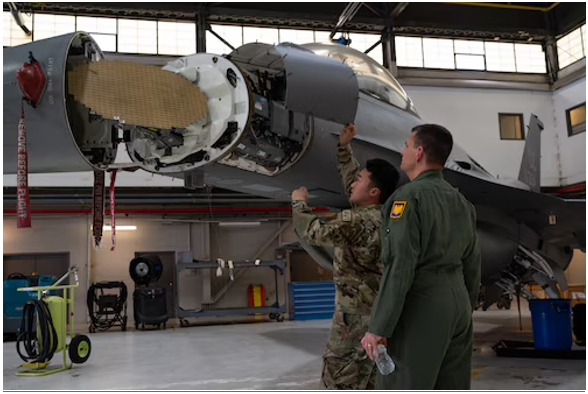 Figure 1: F-16 Fighting Falcon with an upgraded planar AESA radar on the aircraft’s nose. Source: AF.mil
Adaptability
Radar has traditionally been deployed for a single use, largely due to physical limitations, where mechanically scanned arrays (MSAs) were steered using a single, large antenna paired with a gimbal to point the beam. AESA radar, on the other hand, can electronically steer multiple beams very rapidly, enabling simultaneous functions such as identify friend-or-foe (IFF) capabilities by detecting and identifying multiple targets while tracking and engaging others.
The broader the operational bandwidth of the AESA radar, the more versatile the system is. Wider bandwidth AESA systems can transmit more data and improve range resolution in contested environments. These systems are also less susceptible to jamming, giving the user a stronger ability to adapt to the military theater. This, of course, requires wider bandwidth components. Smiths Interconnect offers low-profile, broadband microstrip circulators and isolators with low mass, facilitating integration into L-, S-, C- and X-band radar systems. Discrete components like these are continuously relied upon to enhance radar performance.
Despite advancements in radio technology, such as direct RF conversion, the operation of discrete RF components — filters, attenuators, low-noise amplifiers (LNAs), power amplifiers (PAs), mixers and oscillators — remains crucial to system performance. This is evident in Figure 2, which presents a basic block diagram of a TRM in which the phase shift is performed digitally rather than using phase shifters. AESA radar demands often push the performance boundaries of these components.
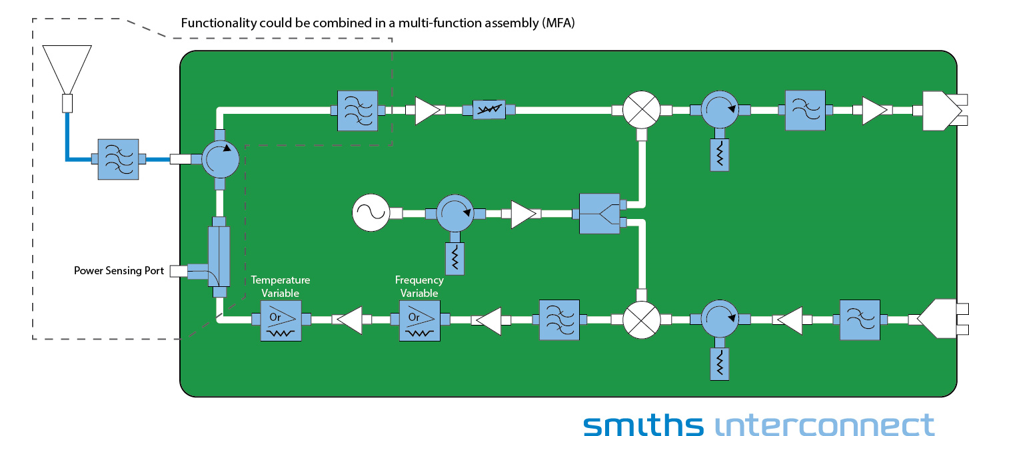 Figure 2: TRM block diagram. Smiths Interconnect product portfolio in blue. Source: Smiths Interconnect
Maximizing range
The radar loss budget will vary based on many factors, including the number of TRM elements, the transmit power of each element, operational frequency, propagation effects like atmospheric absorption, the target radar cross section (RCS), beamwidth/field of regard (FOR), beam shape losses, inherent losses in both the transmit and receive signal chains and more.
Generally, three main factors can improve radar range:
· Reducing system losses
· Reducing interference
· Increasing system power
The most apparent solution to maximize range is to increase system power. But ideally, options 1 and 2 are optimized before moving on to option 3. System losses can be minimized by selecting quality components, for instance, minimizing noise in the receive chain and losses in the transmit chain.
High-transmit powers in radar systems come with thermal management challenges. These design constraints necessitate power-dense substrate technologies that offer high power densities and thermal conductivities.
Smiths Interconnect provides RF resistives built on chemical vapor deposition (CVD) diamond substrates. Components such as attenuators, resistors and terminations from Smiths Interconnect offer the highest power density available, owing to diamond’s unparalleled thermal conductivity.
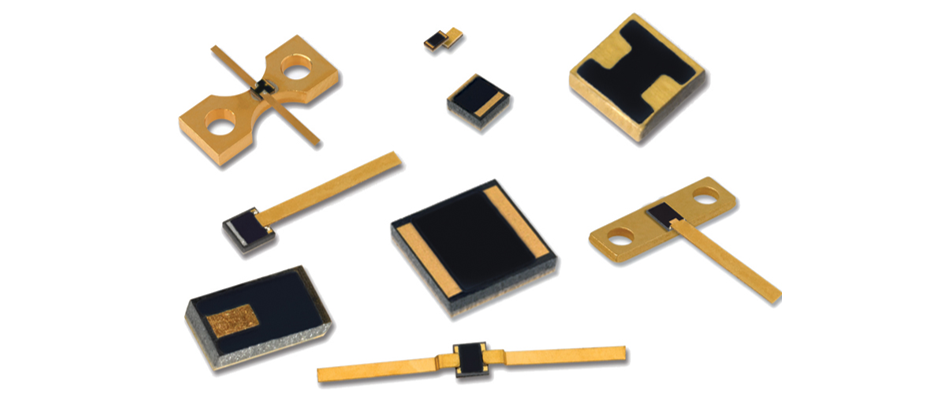 Figure 3: CVD diamond attenuators, resistors and terminations. Source: Smiths Interconnect
Similarly, interference can be minimized by carefully selecting components for mitigation. Low insertion loss, high rejection (Q) filters provide steep skirts, high selectivity, narrower bandwidths and can have excellent power-handling. Smiths Interconnect offers a wide range of filter topologies, such as cavity, waveguide, ceramic, discrete and printed filters, to provide customers with the optimal solution for a particular application.
Reliability
Because system reliability is paramount in mission-critical radar, procurement professionals are often tasked with obtaining components from trusted vendors. The vetting process for many of these facilities involves certifications and audits that ensure the manufacturer has an established quality management system to handle many aspects of production, from materials traceability to reliability testing.
Smiths Interconnect has a track record of delivering field-proven products for mission-critical systems across all its manufacturing sites. The site in Dundee, Scotland, for example, has produced and supplied over 215,000 components and equipment for flight (and spaceflight) use, including over 3,000 device types across a wide range of applications.
One example of Smiths Interconnect’s high-reliability components is the patent-pending Mini-Lock connector, which forms a strong mate after an audible click. These components function up to 110 GHz and have been tested in accordance with MIL-STD-202G for vibration.
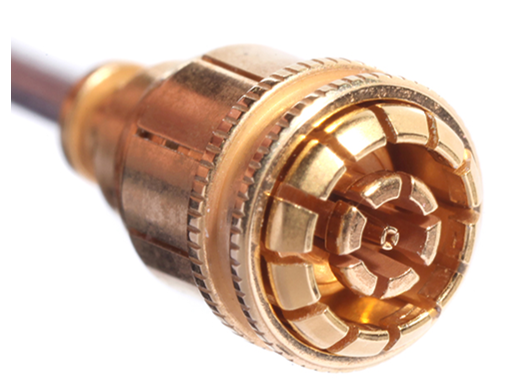 Figure 4: Smiths Interconnect’s Mini-Lock connector RF connector with operation up to 110 GHz. Source: Smiths Interconnect
Lower costs
All too often, greater capability comes at a higher cost, from the prototype phase through to deployment. Many customers rely on Smiths Interconnect’s extensive portfolio of designs to minimize non-recurring engineering costs and take advantage of unique alternatives to traditionally expensive system components.
One example is Smiths Interconnect’s entirely passive Thermopad temperature variable attenuators. Attenuators are critical components in AESA radar for beamforming and signal conditioning. They can be used to taper phase-shifted beams or to adjust an upstream PA’s gain to improve matching by minimizing reflections and removing undesirable instabilities, such as oscillation. In addition, large variations in temperature can affect component performance. For example, as the temperature of high-power amplifiers increases, their gain can decrease — changing the associated attenuation requirements. Often, costly, active attenuator networks are used for temperature effect compensation. These require bias and therefore increase system power consumption; the patented Thermopad variable attenuators are entirely passive. As result, they do not consume power and are smaller, more reliable, and much less expensive.
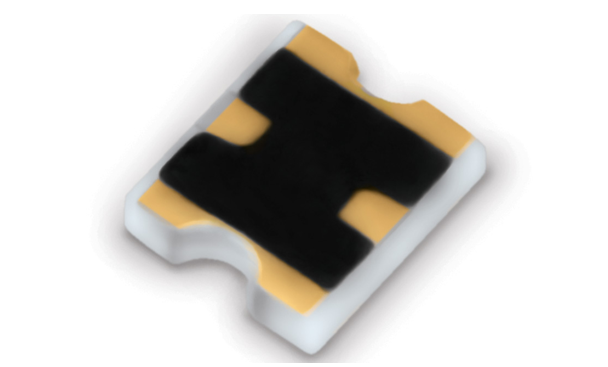 Figure 5: Thermopads are entirely passive temperature variable attenuators that can be paired with PAs to compensate for gain variation over temperature. Source: Smiths Interconnect
Fast deployment
Both cost and deployment time are optimized by streamlining the engineering workflow. Long learning curves are costly, and this can be significantly reduced by partnering up with technical experts. Typically, product procurement is very transactional, with customer orders accompanied by only minimal communication. This purchasing pattern often leads to sub-optimal performance in the first design iteration, necessitating costly re-spins.
Smiths Interconnect’s established experience in radar, including AESAs, enables them to partner with customers and provide design insight and advice. If customization is necessary, Smiths Interconnect delivers prototypes that meet performance requirements quickly, providing shorter timelines to production with dependable on-time delivery, easing the process of optimizing supply chain purchases.
Meeting the needs of modern military tech
Modern military theaters have an ever-increasing number of sophisticated challenges and threats. A radar may face a swarm of drones in one instance and a hypersonic missile in the next. It may have to deploy electronic countermeasures (ECM) to avoid detection or electronic counter-countermeasures (ECCM) to identify objects trying to avoid detection. AESA radar is a key enabling technology for multiple threat engagement and high-accuracy direction finding. The key building blocks of AESA radar systems must often offer wide frequency bandwidths, low loss, minimal distortion and noise, and the ability to handle high transmit powers, all while maintaining high reliability.
Smiths Interconnect is a worldwide leader in the provision of technically differentiated electronic products and components for military applications across land, air and sea. Smiths’ in-house capabilities encompass design, development, manufacturing and testing that anticipate market needs and respond quickly with high-performance, high reliability solutions. To learn more, contact the experts at Smiths Interconnect.