Cooling Towers: Design, Operation and Specifications
Engineering360 News Desk | April 07, 2016Cooling towers are heat removal devices for industrial processes. They are defined as any open water recirculation device that uses fans or natural draft to draw or force air to contact and cool water by evaporation.
(Find cooling towers by Specification or see our Directory of suppliers at Engineering360.)
Cooling towers minimize the thermal pollution of natural water heat sinks and allow the reuse of circulating water. When one thinks of cooling towers, the large towers associated with nuclear power plants probably come to mind. These cooling towers are an extreme case in terms of size, but all function in the same way. These and other smaller towers are used widely in industrial applications.
(Watch a video taken from inside a cooling tower.)
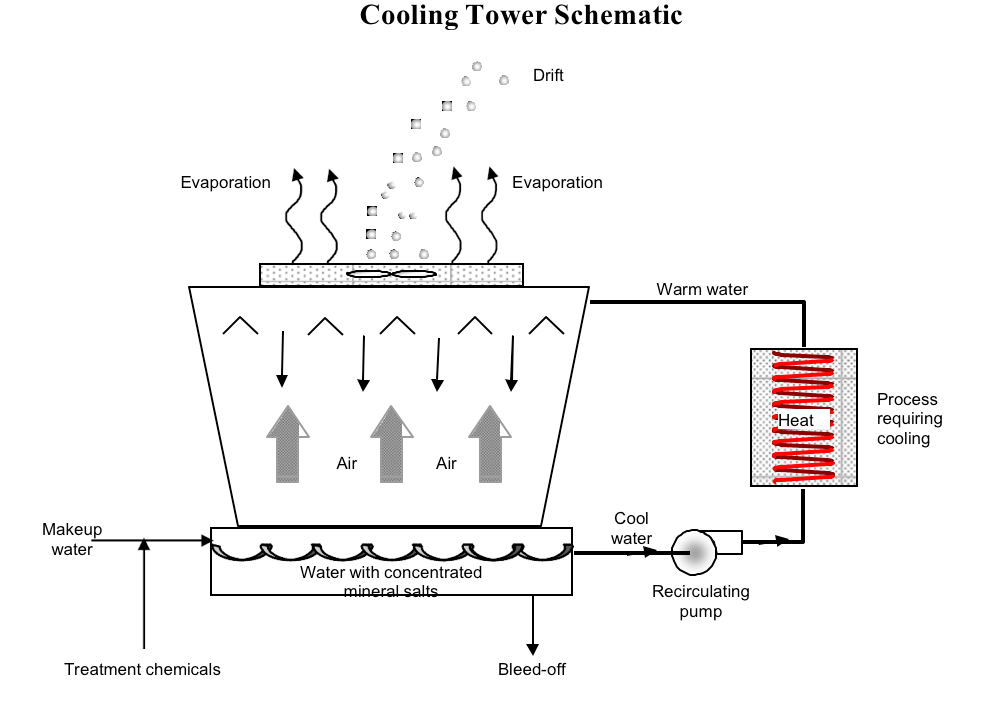 (Click to enlarge) Schematic showing basic components of a cooling tower.The use of evaporation is the primary advantage of cooling towers as a type of heat removal equipment. They are used to provide significantly lower water temperatures than those achievable with air-cooled or dry heat removal processes.
Components and Operation
All cooling towers consist of a few basic components, including the following.
The tower structure (frame) encloses the cooling components (e.g. fans, pipes) and supports the exterior devices (pumps, motors).
The fill (made of plastic or wood) adds surface area and slows water descent to encourage evaporation and heat transfer between the air and water. Optimum packing has a high surface area but low resulting pressure drop.
The cold-water basin or sump basin is located near the bottom of the tower and receives sump water and recirculates it through the system via pumps.
Drift eliminators capture water droplets entrapped in the air stream to minimize water loss.
Fans (axial or centrifugal) are used to move air through the system. Induced systems use axial fans placed near the top of the tower, while forced systems used either type placed near the bottom.
Operating a cooling tower requires the understanding of two separate but interrelated sub-systems: heat transfer and water circulation.