New biosensor tracks airborne viruses in real-time
Marie Donlon | October 01, 2025A biosensor that can detect airborne viruses in real-time and without chemical markers or lab procedures has been developed by a team of researchers from Universitat Politècnica de València (UPV) and Universitat de València (UV).
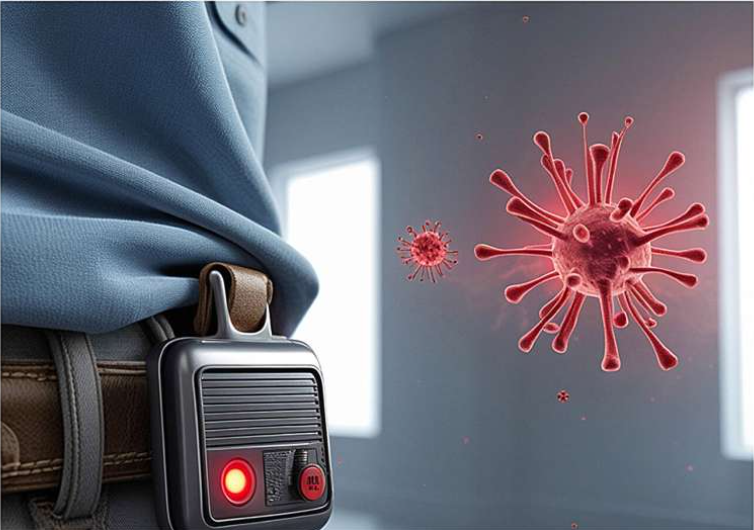
The developers of the biosensor suggest that there is a host of possible applications for the technology such as detecting bacteria in hospitals, schools and on public transportation.
 Source: Talanta (2025). DOI: 10.1016/j.talanta.2025.128192
"After the experience with COVID-19, it is easy to understand that determining the presence of pathogens in the air is vital, as it allows us to take preventive measures. Beyond the coronavirus, there are other microorganisms with a high impact on health and the economy, such as hospital superbugs, avian flu and plant pathogens, which makes it essential to monitor indoor environments," the researchers noted.
Currently, the presence of pathogens in air is detected by sampling the air for a period of time or collecting possible pathogens in Petri dishes or collector solutions. The microorganisms are subsequently identified or quantified in the lab. This process is reportedly time-consuming, taking days. Other similar processes, meanwhile, require bulky equipment.
The biosensor was developed from scratch, with the team designing and manufacturing the electronics and detecting the M13 virus without the need for additional reagents, as is required with current methods.
"We chose to work with this virus because it is easy to handle and, as a proof of concept, our results can be extrapolated to any other pathogen, in any environment," the researchers concluded.
An article detailing the findings, “LC biosensors (Bio-LC): new resonant sensors for direct detection of airborne viruses,” appears in the journal Talanta.