
Shake no more: Active vibrational control systems for shock and vibration isolation
Ryan Clancy | September 17, 2025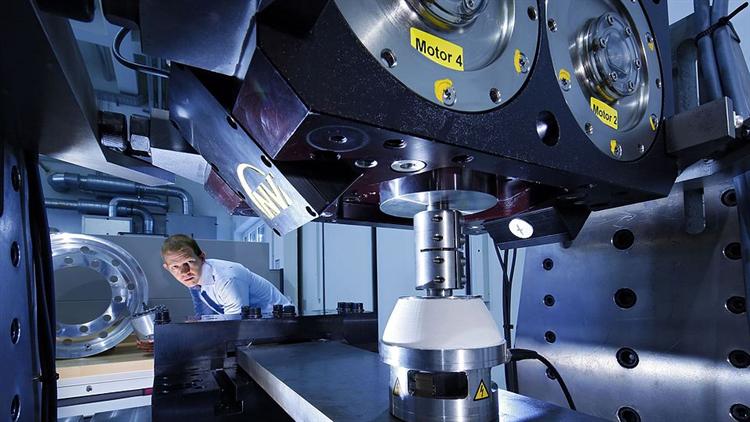 A piezo driven active engine mount cancels the vibration resulting from several motors on top of the mount by inducing countervibrations. Source: Thomas Ernsting/CC BY-SA 4.0
Active vibration control systems are vital in industries that require the stability of precision machinery in environments susceptible to shock or vibration. These systems were designed to provide sensitive equipment with vibration isolation and damping that improve performance and longevity.
Since the systems continuously monitor and respond to environmental disturbances, operations are highly accurate while critical components are protected. Some core principles of active vibrational control should be examined, along with real-world applications and how such technologies can be optimized using data acquisition systems for vibration.
How active vibrational control systems work
Active vibrational control systems continuously monitor vibrations and adjust their responses in real-time. Active systems employ sensors to detect vibrations and actuators to generate counteracting forces, unlike passive systems that rely on shock-absorbing materials. These forces, managed by control algorithms, effectively cancel out unwanted movements.
The system's real-time feedback loop allows continuous adjustment, adapting to vibrational patterns. This adaptive mechanism ensures higher levels of precision and stability in machinery or structures, significantly reducing vibrations that could otherwise impact performance or cause wear. As a result, active vibrational control systems are vital for optimizing performance and improving machinery longevity in high-precision applications.
Applications of vibrational control in sensitive environments
Active vibration control systems are extremely important for environments where even the least disturbance may lead to great disruptions. Some industries in which such high precision and stability determine the reliability and accuracy of sensitive instruments include space exploration, manufacturing, medical equipment and semiconductor fabrication.
For example, in medical imaging systems, like MRI machines, the active control of vibration prevents small vibrations from the machines from perturbing the system's clarity and performance. For precision machine tools, such systems ensure that the vibration does not influence the accuracy of the cut or quality of the surface during the treatment of the material, which is very important in manufacturing with high tolerance. This helps ensure equipment stability during semiconductor fabrication production, where even minimum misalignment can destroy a chip.
These applications underline how important active vibration control is to maintain precision and the longevity of sensitive equipment and for better general performance in such vibration-exposed conditions.
The importance of real-time data for shock and vibration isolation
Active control of vibrations depends on real-time data for the effectiveness and reliability of shock and vibration isolation systems. This gives engineers immediate information on system performance and allows immediate, precise adjustments to nullify the vibrations or shocks. Without real-time feedback, a lag can occur in the system's response to disturbances, affecting stability, accuracy and lifetime of sensitive equipment.
Real-time vibration measurement systems provide engineers with vital data on the frequency and intensity of disturbances. This information is valuable in enhancing precision and response within shock and vibration isolation systems since immediate corrective actions can be made using this data. This is of special importance for sensitive machinery, as it needs to maintain absolute stability during operation.
The performance of the vibration control systems is optimized with engineers using real-time data to ensure equipment stability by avoiding high amplitudes of vibration that would cause damage due to sudden shocks. This proactive handling of unwanted vibrations improves machinery performance while extending the lives of precision equipment.
Types of vibrational disturbances in industrial environments and their impact on machinery
This section deals with the types of vibrational disturbances in industrial environments and their specific impacts on precision machinery. These may differ depending on the operational environment; understanding their nature is essential for optimizations concerning the vibration control strategy.
Mechanical vibrations are often associated with heavy machinery and the continuous running of conveyors or motors in various manufacturing industries. External traffic or construction activities in medical facilities such as hospitals or laboratories can cause building vibrations that could interfere with sensitive medical devices.
On the other hand, thermally induced mechanical vibrations due to variable temperature variations in the space and semiconductor industries introduce serious misalignment in precision equipment.
Conclusion
The stability and longevity of the precision machinery of industries subjected to various types of shock and vibration depend on the active vibrational control systems. From medical imaging to semiconductor fabrication, the result is enhanced performance and durability thanks to instant tracking and response of the systems to ambient disturbances. Blending real-time data and advanced algorithms for control enables immediate corrective action, reducing the possibility of damage due to excessive vibrations. With further development and increasing demand for precision within industries, such active systems of vibrational control will also become increasingly important for protection and optimization in high-precision applications.



There are two ways to analyse the behaviour and examine if the resonance shape is dangerous or not. Modal Analysis and operational analysis. With modal analysis you can catch the dynamical stiffness and those important frequencies. Of course temperature is moving these peaks but you should recognize the form. Through OVA you get information over whole RPM area (sometimes one have to use cooled sensors like f.i. on exhaust systems in combustion engine), and now comes my RMA (relative movement analysis program) in picture. I can calculate with stripping and reorganising the information bending in 10E-3 mm over structure or relative movement over hanger. If someone could give this information in FE calculation, the stress could be evaluated exactly with real time information. Based on frequency in these resonance situations one can also evaluate if this condition is sever like as durability issues and foremost gives information if using map is available estimation how often one will hit in "life-time" this point. Of course some common sense and experience is needed here, but with these tools one can get very close to reality instead of theoretical CAD pictures. I have used this method in german car industry development as example how much is gearbox bending against engine casing, or which RPM points should be chosen for resonance durability test for exhaust systems or how to adjust engine mounting in for combustion engine using animation of structure , combustion pressure statistics and my RMA program.