Hand-Held Device Provides Early Warning of Leaks, Explosives
By Engineering360 News Desk | April 05, 2016University of Utah (UU) engineers have developed a new type of fiber material for a hand-held scanner that can detect small traces of alkane fuel vapor, providing early warning of leaks in an oil pipeline or airliner, or for locating a terrorist’s explosive.
Currently, there are no small, portable chemical sensors to detect alkane fuel vapor because it is not chemically reactive. The conventional way to detect it is with a large oven-sized instrument in a lab.
“It’s not mobile and [it is] very heavy,” says UU Materials Science and Engineering Professor Ling Zang. “There’s no way it can be used in the field. Imagine trying to detect the leak from a gas valve or on the pipelines.”
UU researchers, led by Zang, developed a type of fiber composite that incorporates two nanofibers transferring electrons from one to the other. “When an alkane is present, it sticks in between the two materials, blocking the electron transfer between the two nanofibers,” says postdoctoral fellow Ben Bunes. That interaction then signals the detector that the alkane vapor is present.
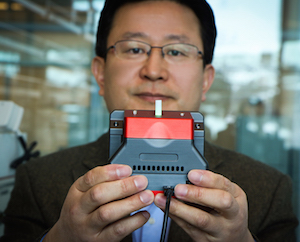 UU Professor Ling Zang holds up the prototype hand-held detector. Image credit: UU College of Engineering/Dan Hixson.Vaporsens, a UU spinoff company, has designed a prototype hand-held detector with an array of 16 sensor materials that can identify a broad range of chemicals, as well as explosives. The new composite material will be incorporated into the sensor array to include the detection of alkanes.
Vaporsens plans to launch the device commercially in about a year and a half, says Zang, who is the company’s chief science officer.
A hand-held sensor device that can detect alkane vapor has three immediate markets:
· Oil pipelines—Typically, leaks in pipelines can be detected only if they are large enough to cause a drop in pressure. Zang’s portable sensor, when placed along the pipeline, could detect much smaller leaks before they become bigger.
· Airplane fuel tanks—Fuel for aircraft is stored in removable “bladders” made of flexible fabric. Zang’s sensors could be placed around the bladder to warn a pilot if a leak is occurring in real time and where it is located.
· Security—Many explosives, such as those used in the 1995 Oklahoma City bombing, incorporate fuel oils such as diesel as one of their major components. These fuel oils are forms of alkane.