Modular, hybrid, adaptable: Connectors get flexible
September 01, 2026In most popular consumer electronics systems, modularity is out — at least for the end user. Sealed units, limited repairability or customization, and wireless-only connectivity are the order of the day. In a few markets — custom gaming PC builds, for example —users still select each component to connect together. But for the vast majority, the device is all (in one) or nothing.
That trend is most clear in the smartphone market, where modular systems periodically become a fashionable idea (motivated by a desire to upgrade, say, a camera unit without junking the handset) but are rarely commercialized.
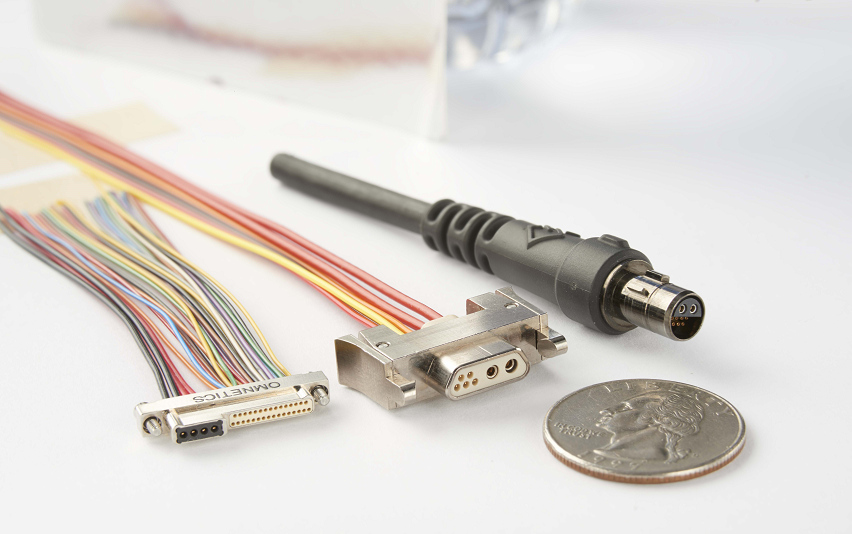 Figure 1: Sealed units, limited repairability or customization, and wireless-only connectivity are the order of the day. Source: Omnetics Connector Corporation
System-on-a-chip — where the function of formerly discrete components is subsumed to the main CPU — is the ultimate expression of this movement, resulting in a range of computerized products with fewer and fewer hardware modules and physical connections.
Don’t make the mistake of thinking this means modules don’t exist — or that connections between them aren’t critical. Even in a sealed-unit smartphone, versions of micro-connectors are still vital to enable the connection of a camera, touch screen and other components. If anything, the quality and reliability of those connectors must be even higher if they can’t be replaced easily.
Against the grain
And in more mission-critical environments and for applications that require greater investment in hardware — such as the military, but also medical devices and aerospace — the drive to solid-state, non-user-adaptable devices is much less attractive. Core componentry can be integrated; but functionality relies often on specialized, disposable or redundant modules.
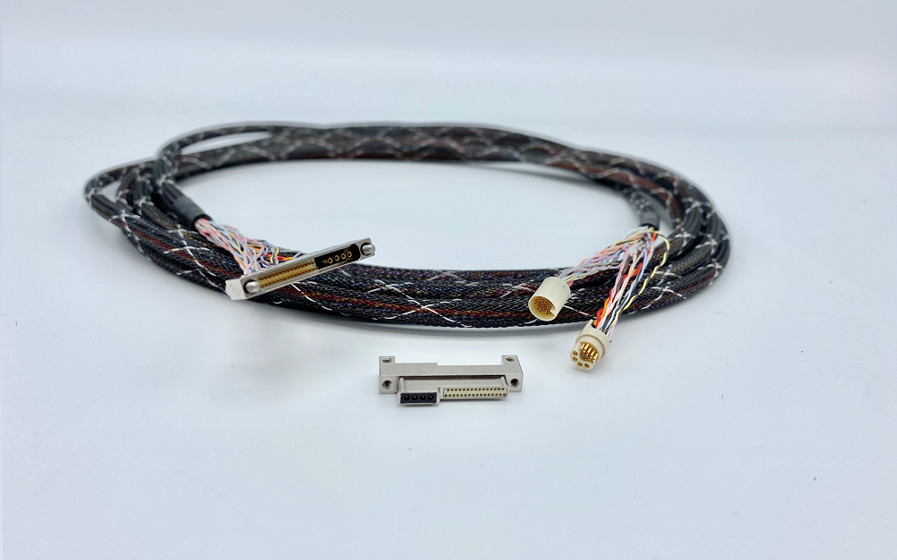 Figure 2: Typically, these designs break large, complex systems into smaller, independent modules that can be developed and tested separately, and then combined to form the final package. Source: Omnetics Connector Corporation
Typically, these designs break large, complex systems into smaller, independent modules that can be developed and tested separately, and then combined to form the final package. For instance, an unmanned aerial vehicle (UAV) or drone will have a flight controller at its heart, with multiple circuit boards containing gyros and accelerometers, along with processors and memory. But plugged into that will be GPS, video transmitters, power distribution boards, data logging systems and even servos to operate grabbers or release mechanisms.
This approach has several benefits in mission-critical situations, including:
- Improved reliability: Because each module is developed and tested independently, modular design reduces the likelihood that a failure in one module will affect the performance of the entire system. This can improve the overall reliability of the system, making it more suitable for mission-critical applications.
- Enhanced flexibility: Modular design allows different modules to be easily swapped out and replaced, which can improve the flexibility of the system. This can be useful in situations where the system needs to be adapted to changing conditions.
- Faster development and deployment: Because modular design allows different parts of the system to be developed and tested in parallel, it can speed up the development and deployment process. This can be particularly beneficial where time to adapt is a factor.
However, modular design also has some disadvantages, including:
- Increased complexity: It can increase the overall complexity of a system. This can make it more difficult to understand and maintain.
- Higher costs: It typically requires more specialized expertise and development resources. This can be a disadvantage in situations where cost is a major concern.
- Compatibility issues: If different modules are not designed to work together properly, this can affect the performance of the system and potentially compromise its reliability.
Talking the talk
One particularly acute challenge is that many systems now require multiple modules performing many different functions. And that’s where connectors and cabling come in. Being able to hook up different elements into a coherent system without worrying that it is introducing a weak link is critical.
An additional risk is while the “system-on-a-chip,” or solid state, approach is fairly binary — either the drone flies or it doesn’t; the system boots or it bricks — with a more modular approach there are more potential points of failure. That means ensuring power and data — often different kinds of both — are properly routed through the system as a whole is key.
Different parts of a modular system typically connect together via cables or connectors. The components may also be connected via networking hardware or wireless connectivity. The choices about those connectors will come down to several factors: the speed of connectivity, cost, robustness and security of the system. Other factors such as the type of data being transmitted and the environment in which the system will be used will weigh the decision.
The main types of connectors that link together different parts of a modular system might include Ethernet, USB, HDMI, serial and power connectors. Each type of connector is designed to transfer different types of data or power, making the right type of connector choice critical. Even in specialized military, medical and aerospace applications, those aforementioned standards (commonly used to connect consumer devices) might be part of the picture.
But for many applications — especially those placing a premium on space, or that connect multifunction components within the overall system — the obvious choice is hybrid connectors chosen specifically for the application or unique configuration of the platform. These can route both power and signals in one reliable connection, which has huge advantages in different environments.
For medical devices, for example, a simple plug-in or latch-based system connecting a component like a probe or sensor to a main device means that failure of either can be managed much more quickly without compromising the patient. Transferring multiple cables or connections is both open to user error and may take valuable time.
In remotely operated systems — military-grade drones, for example, or cube satellites — high-reliability hybrid connectors both save space and can be designed to optimize protection from harsher environmental factors, too.
Think USB…but reliable
That level of robustness in mission-critical situations is what separates Omnetics’ hybrid connectors from the consumer level hybrids like USB-C. While USB does transmit power and signals — and is an extremely useful connector standard, capable of many functions, including daisy-chaining devices for a form of modularity — being able to separate out the power and signals lines in one connector ensures that tailor-made components can easily be swapped out, and more complex module needs (variable power, say, or inputs from multiple sensors) can be met.
The smallest Omnetics’ hybrid connectors can hook up two power and five signal connections in a unit less than 7 mm in diameter — making it ideal for lightweight, relatively straightforward systems. These simple plug-in connectors offer cheap, compact solutions. But for increasingly complex designs where, for example, central control systems need to hook into more sophisticated sensors or other modules, the standard range of hybrid connector can field up to five power lines and 20 for signals.
It's not just the wire connectivity, either. Unlike the standard plugs — again, think a USB plug pushing into place — today’s connectors come with a variety of housings, from the simple plastic interfaces, through latch systems for more secure fixing, right up to ruggedized metal shells. These can offer a variety of securing options: threaded, breakaway or quarter–turn twistlock configurations.
That allows the engineers designing their systems to optimize around several dimensions — price, weight, size, capacity, complexity, security of aperture and overall robustness.
That last point is key. One of the most important characteristics of high-end hybrid connectors is their ability to withstand extreme temperatures. Many devices that are used in harsh environments, such as industrial equipment and military vehicles, are exposed to conditions that can range from scorching heat to sub-zero cold. Traditional connectors can become brittle and break under these conditions, but hybrid connectors are designed to maintain their integrity and continue to provide a secure connection.
It's worth noting that fault tolerances and environmental robustness must be matched throughout a system. Designing key components around, say, dust ingress or extremes of temperature while spec’ing cheaper connectors is a recipe for disaster.
Connected is everything
The variety of devices being connected is also increasingly important, and in many cases being able to hook up reliably to communications modules, in particular, is a must-have. And while the buzz-phrase “the internet of things” (IoT) has become less popular of late — cheapened, perhaps, as a result of ‘dumb’ household appliances being sold with spuriously-justified internet connectivity — it still has considerable currency in high-stress environments.
IoT describes the use of interconnected sensors and actuators for controlling and monitoring physical environments, as well as the objects and people that move through them. Multiple sensors placed across a variety of domains are used by the internet of military things (IoMT) to obtain complete situational awareness and control over numerous battle zones and conflict zones.
In order to gather, analyze and disseminate data, advanced military forces have invested in C4ISR (command, control, communications, computers, intelligence, surveillance and reconnaissance) systems and infrastructure. Situational awareness is provided by C4ISR systems, while communication and information sharing are made possible by command and control (C2) systems. IoMT strives to integrate all of this data into a unified ecosystem.
During the war in Ukraine, for example, battlefield encounters have been relayed by drones live via GSM or mobile internet connections, and used for recon, fire support and strike evaluation. Wireless connectivity is also useful (although not essential, given on-board GPS) for drone navigation and recovery.
Only as strong as the weakest link
If connectors are faulty or low-quality, it can pose several risks, including:
- Data loss or corruption: Either during transmission or within the platform itself, compromising performance and reliability. This can be particularly problematic in mission-critical situations where the accuracy and integrity of the data are critical.
- Power interruption: Low-quality or faulty connectors can also cause power interruptions, which can affect the performance of the system and potentially cause it to fail.
- System failure: The use of faulty or low-quality connectors can also lead to overall system failure, either by causing individual components to fail or by disrupting the overall functioning of the system.
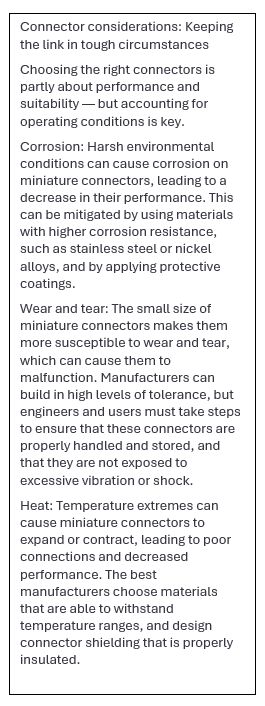
Connectors must therefore be able to tolerate temperature cycling, shock, vibration and even exposure to corrosive substances — which can be especially challenging in an extreme environment — all within a range that would ensure voltage and current are sustained within operating parameters, and there is no significant degradation of data quality (see panel). In military applications, the evolution of counter-drone technology and electromagnetic interference systems is also forcing engineers to consider the shielding applied to different components — and that includes connectors.
But long-established applications for micro-connectors in, say, industrial sensing equipment has been a valuable proving ground for more advanced applications. These micro-connectors enable the connection of a variety of sensors, such as temperature, pressure and humidity sensors, without the need for bulky traditional connectors, allowing the development of smaller and more efficient sensing systems.
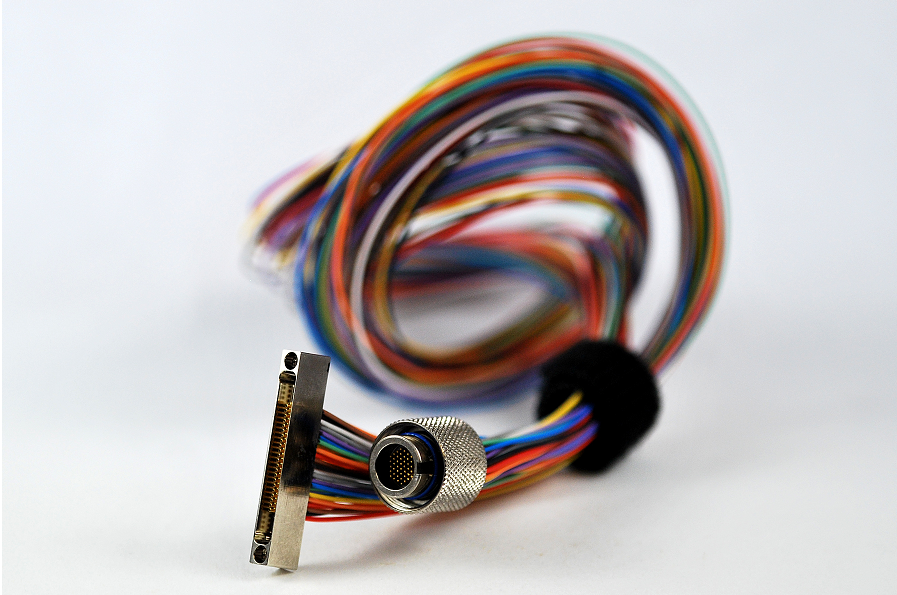 Figure 3: The use of micro-connectors, then, is becoming increasingly important for the development of modular and multi-function devices. Source: Omnetics Connector Corporation
The use of micro-connectors, then, is becoming increasingly important for the development of modular and multi-function devices. With increased reliability, smaller size and weight, and higher data rates, they are being used in a greater variety of applications, from smartphones and medical systems to industrial sensing equipment and autonomous vehicles. As the development of micro-connectors continues, they will become increasingly important for mission-critical applications.