Smooth operators: Protective coatings extend drivetrain
Ryan Clancy | August 31, 2025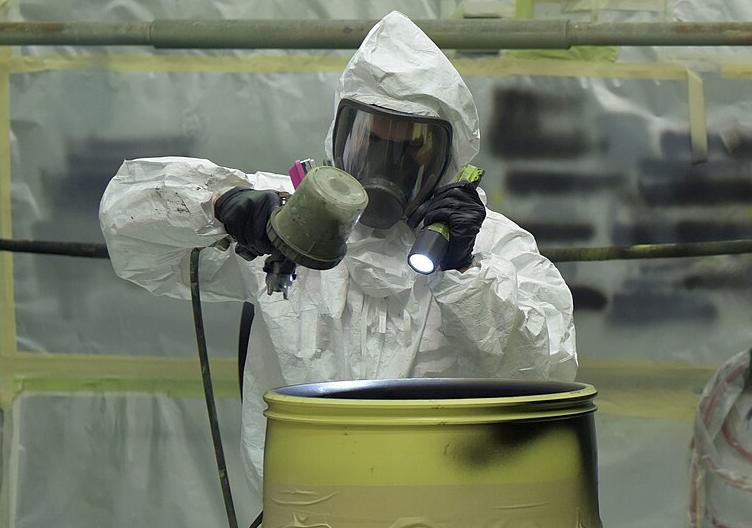 A U.S. Airman coats parts of a plane with a mixture of epoxies and other coating materials to prevent rust.
In an ideal world, drivetrain longevity could count on material-toughening heat treatments and high-tolerance machining. Unfortunately, it is a notoriously non-ideal universe, and high-performance gears and shafts will fail prematurely when they’re unprotected. Thermal expansion makes the metal expand and rub, surface imperfections and other wear inducing causative factors exist, too, undermining long-term performance. Worse still, it’s only going to get worse as machines get faster and hotter.
The solution is coatings, protective skins that eliminate contact wear, with low coefficients of friction that perform double duty as friction modifiers, extending component life under punishing operating conditions.
[Read more about protective coatings on GlobalSpec]
The role of power transmission component coatings
The diagnosis of gear and shaft wear is a science all on its own. That’s not exactly surprising, as these mechanical parts are ultimately responsible for keeping machines moving, including cars; they’re basically the glue that holds a power transmission system together. How distressing to system engineers, then, when these perfectly engineered components succumb to tiny surface imperfections.
A manufacturing error, crumb of external debris, even a flaw in lubrication formulation, any and all wear inducing conditions can severely curtail the life of an otherwise superbly fabricated drive shaft or gear. The meshed teeth, flawless when manufactured, experience pitting. And the same scenario occurs in the machine shafts, its bearings losing lubrication and gaining irregular spin characteristics. Again, premature failure is the result and the entire drivetrain suffers a lifespan hit. Here’s a list of some of the more common culprits:
- Lubrication issues: Low oil conditions, lack of maintenance
- Manufacturing imperfections: Poor engineering tolerances
- External loading factors: Heavy axial and radial stressing
- Environmental impact: Everything from vibration to moisture
- Contaminants: Rust particles, external dirt ingress, etc
- Thermal expansion and contraction: Heat and cold affect dimensional integrity
Coatings mitigate many of these factors, though not as an all-encompassing system cure-all. A state of synergy is realized, with the protective finish working in concert with maintenance and superior engineering specifications to greatly extend service life. The coating in question acts as a filmic overlay, microns-thin but robust, canceling out metal-to-metal contact while a self-lubricating mechanism or manually filled oil reservoir keeps a thin layer of liquid or waxy grease flowing between the metal parts . By forming a barrier between moving parts, risks of adhesion wear, plus pitting and galling, are all significantly reduced.
How coating technologies mitigate drive wear
The rest of the subheading should be titled “without impacting performance,” but would have made the heading long and inelegant. Let’s just say that a great deal of research has gone into keeping engineering specs tight, and a thick coating would play havoc with tight dimensions. If the coating was then applied once, to a single gear, then applied to multiple gears in the same ‘train,’ of power transmitting components, the dimensional error would be multiplied. That’s the last thing that is wanted. Thin coatings keep that dimensional aspect precise while delivering greater surface protection gains.
Thin coating technology uses such innovative materials as nano-structured ceramics, Diamond Like Carbon (DLC), and advanced composites. These coatings are only a few microns thick, yet they provide hardness levels that rival or exceed equivalent metal overlays. As for how these fine layers are deposited, PVD (Physical Vapor Deposition) is the process that was chosen. For this solution, carbides, DLC, or nitrides are vaporized in a vacuum-sealed chamber. The plasma or ionized mass travels through the vacuum and is deposited on gear teeth and shaft surfaces at a molecular bonding level, so as not to impact parts geometry.
Highlighting the nitride coatings class, Titanium Nitride (TiN) and Titanium Aluminum Nitride (TiAIN) stand out due to exceptional hardness, plus the added benefit of a low coefficient of friction. Carbide substitutes appear next in coatings tables; they typically possess even lower friction coefficients, their only limitation being a low oxidizing temperature that keeps them from being used in hot-running machines. For high-performance gearing drivetrains that encounter higher temperature ranges, nitride coatings are the de facto gear and shaft protective coating.
Operational instances where coatings are the only answer
Sometimes gears and shafts never receive coatings. They’re case-hardened or heat treated to maximize durability. A lubricant is added, perhaps via a reservoir or some cleverly introduced self-lubrication system. Everything works until it doesn’t, the machine goes down in a messy bang of failing gears. Still, the option is practical at times, especially in heavily loaded power transmissions, because case hardened treatment goes beyond the surface, increasing overall shaft and gear material strength. It all depends on the usage scenario in question.
What if there’s no lubricant at all, though? That puts the situation firmly back in coating territory, lengthening drive durability. It does happen, especially in machines where lubricants are impractical. Think of the hygiene sector, of food processing and medical equipment, places that demand contaminant free machinery. Oily lubricants would never be permitted here. Meanwhile, at the opposite end of the spectrum, cryogenic environments present unique challenges. Lubricants freeze, solidify, or lose effectiveness under extreme cold. In both of those circumstances, a super-hard coating with a low coefficient of friction is highly desirable.
The future of high-performance gearing
There’s no great secret behind how coatings extend gear and shaft lifespans. They create an ultra-hard barrier between power transmission contact zones without interfering with drivetrain geometry. The lower rung of such protective features start with materials like black oxide and PTFE, but it’s an option that wears quickly and provides only basic corrosion protection. Nickel plating is the next moderately capable solution, but micro-cracks appear as loads increase. PVD is a superior answer, especially as performance oriented applications increase.
 Simple black oxide in it's powdered form.
More and more drive packages with case hardening or PVD coatings are now being seen, or, even more likely, a combination thereof.
Looking ahead a little, electric vehicles (EVs), robotics, and aerospace engine optimizations will only accelerate the demand for coatings that combine extreme wear resistance, low friction, and thermal stability, all in a compact PVD coated package. EV reduction gears, for example, operate at higher RPMs and torque levels than many legacy automotive systems, leaving no margin for friction losses or lubricant breakdown. Add to that the rising emphasis on dry-running designs in clean-room environments, from semiconductor tools to medical robotics, and the role of thin-film gear and shaft coatings becomes indispensable. Powertrain seals remain closed from access for longer periods, only opening up to be maintained over the course of several years, if at all.
And while that sounds like the end of the story, it’s really just the beginning. As power density grows and mechanical complexity shrinks, surface engineering will keep power transmission systems running friction-free, with the added bonus of reduced battery capacities on those long-range EVs of the future.