Solar cells capture the light indoors
S. Himmelstein | September 15, 2025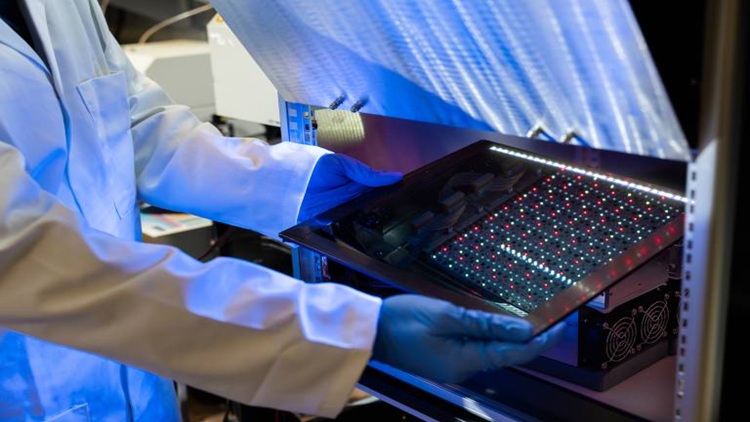 Source: University College London
The deployment of photovoltaic technology in the indoor environment holds promise for harvesting energy from artificial light sources. The realization of such power sources is key for the battery-free operation of wireless keyboards, sensors, remote controls and other devices. In pursuit of this interior electricity supply, a group of international researchers has engineered an indoor solar cell with enhanced functionality and efficiency.
Crystal defects commonly encountered in perovskite films were eliminated by application of a triple passivation treatment (TPT) aimed at suppressing crystal defects in the perovskite film. The addition of rubidium chloride, N,N-dimethyloctylammonium iodide and phenethylammonium chloride reduced defects and boosted the utility of the perovskite indoor solar viable indoors. X-ray diffraction analysis confirmed that the treatment effectively eliminates defects and the photoluminescence intensity of the resulting films increased by 3.6 times relative to untreated material.
When tested under standard indoor illumination conditions, the solar cells achieved a power conversion efficiency of 37.6%. The devices also retained 92% of their initial efficiency after being stored for 3,200 h at room temperature and 5% to 10% relative humidity, A control perovskite device fabricated without the passivation treatment retained only 76% of its initial performance. Under 300 hours of continuous intense light at 55° C, the new solar cells retained 76% of their performance while the control device dropped to 47%.
Researchers from University College London (U.K.), Ordos New Energy Research Institute (China), Imperial College London (U.K.), London South Bank University (U.K.), Ecole Polytechnique Fédérale de Lausanne (Switzerland) and Phoenixolar Co. Ltd (China) contributed to this development, which is described in Advanced Functional Materials.