Grapevine waste transformed into biodegradable films for eco-friendly packaging
Marie Donlon | August 24, 2025Researchers from South Dakota State University have found that grapevine canes can be transformed into a plastic-like material that is stronger than traditional plastic and that promises to decompose in the environment in a short amount of time.
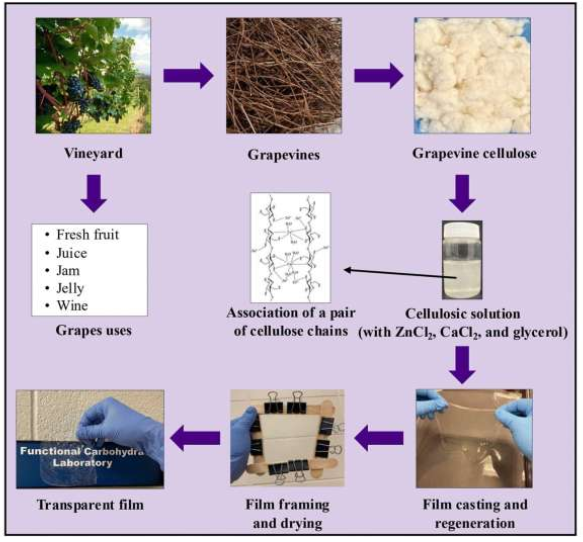
Specifically, the team is working to develop a plastic-like bag that will decompose in the environment. To accomplish this, the team used cellulose, which is a biopolymer that is the most abundant organic substance on Earth and is found, most often, in the cell walls of plants. Cellulose gives plants their structure and rigidity thanks to its strong hydrogen bonds and a chain of glucose molecules.
 Source: Sustainable Food Technology (2025). DOI: 10.1039/D5FB00211G
The researchers explained that they extracted cellulose from grapevine canes — which is the woody plant material that grapes grow and that are rich in cellulose — to create food packaging film. According to the researchers, grapevine canes are abundant and have limited use after harvesting.
Once developed, the grapevine cane films proved transparent and strong. Importantly, the grapevine cane derived film biodegrades within 17 days in the soil, leaving behind no harmful residue. As such, the team believes that these films show potential for food packaging applications.
Once harvested, the grapevine canes were dried and ground, and the cellulosic residue extracted. That residue was then solubilized and cast onto glass plates to form the films.
During trials, grapevine cane-derived films proved stronger than traditional plastic bags — in terms of tensile strength.
"Using underutilized grapevine prunings as a cellulose source for packaging films enhances waste management in the field and addresses the global issue of plastic pollution," the researchers noted. "Developing eco-friendly films from grapevine cellulose represents a practical approach to sustainability, helping to conserve the environment and its resources and contributing to the circular bioeconomy."
An article detailing the film, “Valorization of grapevine agricultural waste into transparent and high-strength biodegradable films for sustainable packaging,” appears in the journal Sustainable Food Technology.