Aquifer thermal energy storage for renewables
S. Himmelstein | July 17, 2025Pilot tests of an aquifer thermal energy storage (ATES) system are underway by Mitsubishi Heavy Industries Thermal Systems and Osaka Metropolitan University in Osaka, Japan. The system is intended to store renewable energy and produce cooling for air conditioning in the summer or heating in winter. An energy absorption and release technology is deployed that allows short-cycle thermal storage and discharge functionality, enabling flexible switching between cold and heat storage.
Renewable power from wind and solar sources is used to pump water up from underground reservoirs and heat or cool this water at the surface during the summer or winter, respectively. Gravel and groundwater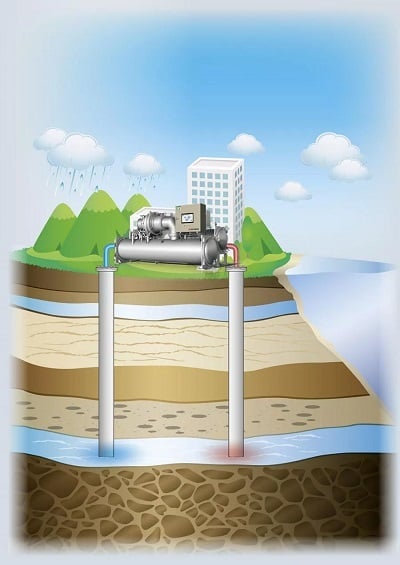 Diagram of an ATES system. Source: Mitsubishi Heavy Industries Thermal Systems stored in aquifers deep underground serve as the heat storage tank. Heat or cooling can be delivered with a small amount of stored renewable electricity, according to the company.
The ATES system can directly use 10,000 m3 of groundwater stored at 5° C in a cooling well, made possible by a multi-layered seasonal storage function that allows lower-temperature chilled water to be stored within existing underground cold-water masses.
The developers expect the technology to achieve a charge/discharge efficiency target of 70% when the upper limit of pumped water temperature used for direct cooling is 13° C. “This system adds two new functions to the conventional ATES: storing surplus renewable energy electricity in cold wells at 5° C using a heat pump heat source based on real-time information on the amount of electricity; and directly cooling the electricity using groundwater stored at 5° C,” explained the researchers.