Concrete revolution: AI offers speedy cement in seconds
Cari Cooney | June 30, 2025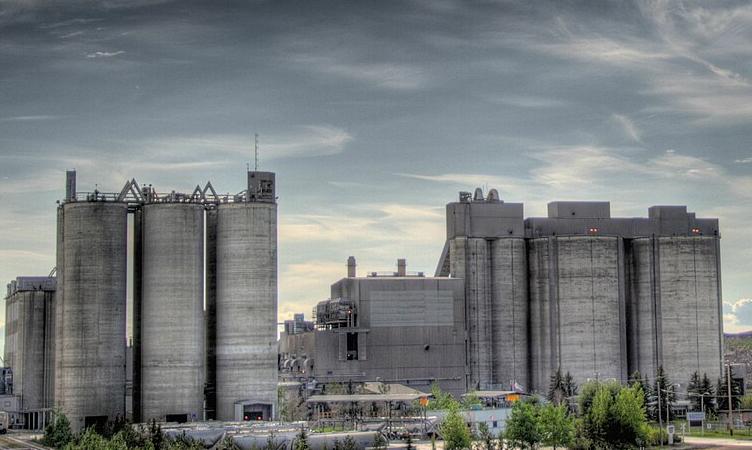 Inland Cement Plant in Edmonton, Alberta, Canada
The cement industry releases more CO2 into the air than the whole aviation industry throughout the world—about 8% of all CO2 emissions. Researchers at the Paul Scherrer Institute (PSI) have created an AI-based algorithm that speeds up the search for new cement compositions that might have the same quality but a less carbon impact.
Cement manufacturers' rotary kilns are heated to 1,400 degrees Celsius to convert pulverized limestone into clinker, the basic ingredient for ready-to-use cement. Unsurprisingly, these temperatures are often not achievable just by the use of energy. They are the outcome of energy-intensive combustion processes that produce high volumes of CO2. What may surprise you is that the combustion process accounts for far less than half of these pollutants. The majority is found in the raw materials used to make clinker and cement: CO2 is chemically bonded in limestone and is released during its transformation in high-temperature kilns.
One viable option for lowering emissions is to change the cement formula, substituting part of the clinker Concrete is the most widely-used building material globally. Credit: Paul Scherrer Institute PSI/Markus Fischer with other cementitious materials. That is exactly what an interdisciplinary team at PSI's Center for Nuclear Engineering and Sciences has been looking into. Instead of depending on tedious experiments or complex scenarios, the researchers created a machine learning-based modeling technique. "This allows us to simulate and optimise cement formulations so that they emit significantly less CO2 while maintaining the same high level of mechanical performance," says mathematician Romana Boiger, the study's primary author. "Instead of testing thousands of variations in the lab, we can use our model to generate practical recipe suggestions within seconds - it's like having a digital cookbook for climate-friendly cement."
The researchers were able to pick out only the cement formulas that met the specified criterion thanks to their new method. Nikolaos Prasianakis, leader of the Transport Mechanisms Research Group at PSI and one of the study's initiators and co-authors, adds, "The range of possibilities for the material composition, which ultimately determines the final properties, is extraordinarily vast." "Our method lets us speed up the development cycle by picking promising candidates for more experiments." The journal Materials and Structures published the study's results.
Finding the perfect recipe
Industrial waste like slag from making iron and fly ash from coal-burning power plants are currently being utilized to replace some of the clinker in cement mixes. This lowers the amount of CO2 that is released into the air. But there is such a huge need for cement around the world that these products can't meet it. John Provis, head of the Cement Systems Research Group at PSI and co-author of the study, says, "What we need is the right mix of materials that are easy to get in large amounts and can be used to make high-quality, reliable cement."
Unfortunately, it's hard to find these combinations: "Cement is basically a mineral binding agent. In concrete, we use cement, water, and gravel to make minerals that hold the whole thing together," Provis says. "You could say we're doing geology at a fast pace." This geology, or more accurately, the collection of physical processes that make it happen, is quite complicated, and modeling it on a PC is very expensive and requires a lot of computing power. The study team is using AI for this reason.
Acceleration with AI
Artificial neural networks are algorithms that learn from data that is already there to make complicated calculations go faster. The network learns by changing the relative strength, or "weighting," of the internal connections so that it will rapidly and accurately anticipate similar correlations. This happens when the network is trained on a known data set. This weighting is like a shortcut; it's a faster way to do physical modeling that would otherwise take a lot of time and effort.
[See how engineers turn sludge to concrete....on GlobalSpec]
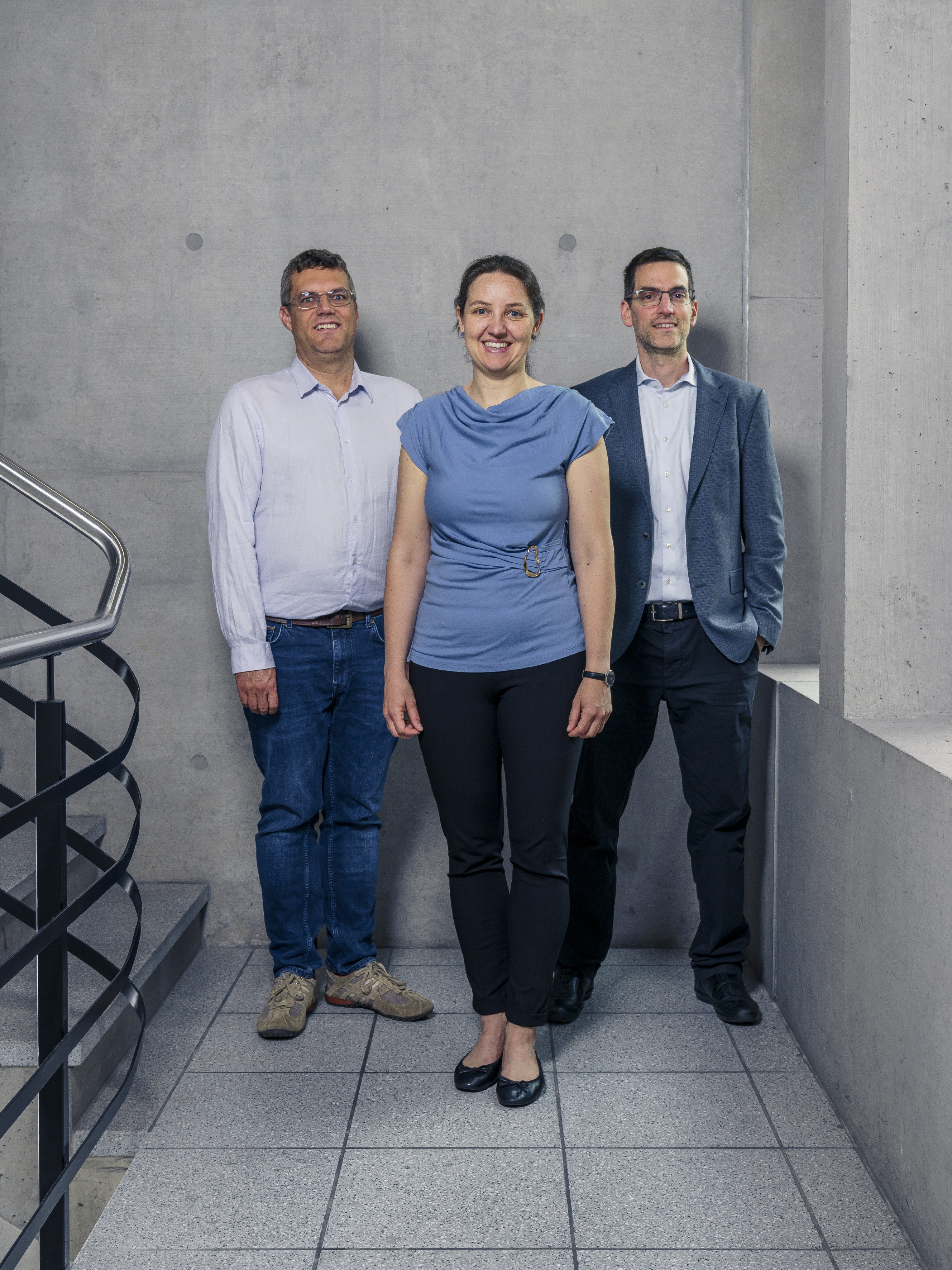 Pictured (from left to right): John Provis, Romana Boiger, and Nikolaos Prasianakis. Credit: Paul Scherrer Institute PSI/Markus FischerSimilarly, PSI's research team used a neural network. They made the data they needed for training: "With the help of the open-source thermodynamic modeling software GEMS, which was developed at PSI, we figured out, for different cement formulations, which minerals form during hardening and what geochemical processes happen," explains Nikolaos Prasianakis. Integrating the findings with testing data and mechanical models gave the researchers a credible indication for mechanical qualities and cement material quality. They calculated total CO2 emissions by applying a CO2 factor to each component. Scientist: "That was a very complex and computationally intensive modelling exercise."
But the effort was worthwhile; with data collected in this manner, the AI model was able to evolve.
The researchers would not have been able to complete the project without their diverse backgrounds. "We needed cement chemists, thermodynamics experts, AI specialists - and a team that could bring all of this together," says Prasianakis. "Added to this was the important exchange with other research institutions such as EMPA within the framework of the SCENE project." The Swiss Center of Excellence on Net Zero Emissions (SCENE) is a multidisciplinary study program that aims to find scientifically sound ways to greatly lower greenhouse gas emissions in energy supply and industry. This project included the successful completion of the study.