Cloud seeding: Can we engineer the rain? Should we?
Grace Watson | July 14, 2025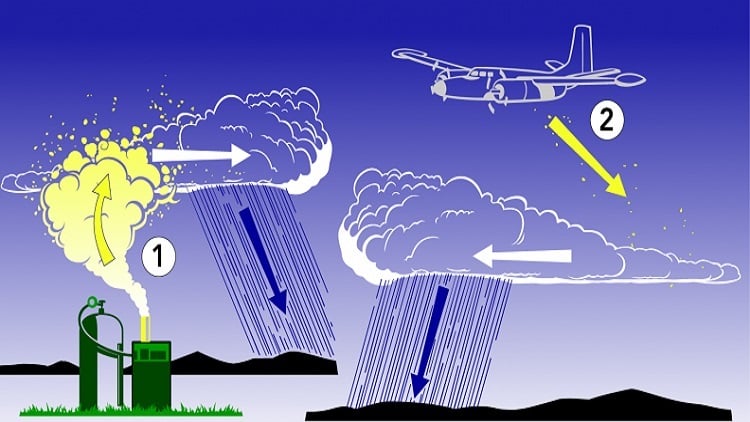 Cloud seeding can be done by ground generators or planes. Source: DooFi/Wikimedia Commons
Cloud seeding is a concept that was sowed in the 1940s. Vincent J. Schaefer, Bernard Vonnegut and Irving Langmuir were researching icing on aircraft in 1946 and found that they could create snow by adding small particles to a simulated cloud inside a freezer. They then discovered that silver iodide was an effective way to accomplish this.
This led to an experiment in 1947 dubbed “Project Cirrus.” A B-17 bomber was modified and dropped solid carbon dioxide in the form of two hundred pounds of dry ice into a stratus cumulus cloud. It was dumped into a cyclone off the coast of Florida, which created a visible downdraft — a net effect of rainfall. This proved that precipitation could be controlled. The resulting Project Skywater attempted to increase water supplies in the American West from 1964 through the 1980s, where it quietly died due to budget cuts after years of inadequate funding left it unable to fully prove the concept could work at a large scale.
Cloud seeding is a weather modification technique that can help stimulate a cloud’s ability to produce rainfall or snow. Clouds typically form water droplets around dust or pollen in the atmosphere. However, these small nuclei of particles can be introduced artificially, allowing the clouds to form snowflakes or rain to fall to Earth. The aforementioned silver iodide can be introduced via ground-based generators or aircraft.
Why seed clouds?
Cloud seeding is used all over the world for increasing winter snow and mountain snowpack. The Russian Federation and Thailand use cloud seeding for heat waves and wildfires. The U.S., China and Australia rely on the technology to enhance water supply. The United Arab Emirates uses it for heat reduction and agriculture.
It has also been used to increase snowfall, especially for snow tourism. In Nevada, snowpack has increased by 10% and in Wyoming, over a 10-year period, 5% to 15% higher snowpack was observed. In New South Wales, Australia, a 14% increase was found in snowfall. In fact, in the U.S., its primary purpose is to increase snowfall. This can also provide water for millions in the spring when it melts. However, it can also be used to mitigate risks from severe storms and trigger rainfall in drought-stricken areas
For decades, the western U.S. has been in a mega drought. And although 2023 was extremely wet for the West, the net effect for the region is clear: the last two decades have seen some of the driest conditions. Lake Mead has hit historic lows. Last January’s devastating Los Angeles fires were exacerbated by the dry conditions. Water flow has slowed in major water bodies like the Rio Grande and Colorado Rivers, leading to municipal court battles over water supplies.
Has it been working?
It is difficult to prove that cloud seeding is effective. In order to do so, there needs to be a control scenario and a cloud seeding scenario. It is hard to know what the natural weather will do. Advanced monitoring technology (e.g., high-tech radar) is required. In 2003, the National Research Council published a report indicating no scientific proof for its efficacy. A 2024 study by the U.S. Government Accountability Office found that the benefits of cloud seeding are unproven, as it is difficult to measure and verify, and seeding can only occur when the right type of sufficient clouds are already in the atmosphere — so it can be difficult to predict when to do seeding.
Science has still pushed forward to try to find how to make it work for drought help. Currently, eight states across the nation use cloud seeding. The upper Colorado River Basin’s cloud seeding is managed by Colorado, Utah and Wyoming for $1.5 million per year. This agreement was set in 2018 and extends until 2026. Nevada, California, New Mexico and Arizona also benefit from higher flow in the Colorado River as a result of cloud seeding poised at drought reduction strategies. Since 2018, Wyoming and Colorado have invested heavily in both aerial cloud seeding and ground-based generators.
Around a 5% to 15% increase in snowfall has been observed, based on statistical studies. This means that for a few dollars, the output is about half an Olympic-sized pool. However, the studies still did not show that heavier snowfall was occurring. In 2015, the U.S. Bureau of Reclamation determined that cloud seeding was still not proving super beneficial yet.
It was not until 2017 with the SNOWIE project (Seeded and Natural Orographic Wintertime Clouds) that the very first quantitative evidence was documented: perfect testing conditions led to the formation of over 286 Olympic-sized pools worth of snowfall from three days of cloud seeding. This project has allowed for more studies and computer model validation. However, there is still not significant data to show that cloud seeding will do anything to save the West from droughts.
Cloud seeding as the answer to droughts
Cloud seeding is simply not the ultimate answer to solving the ongoing drought epidemic. This is because for a cloud to form and produce rainfall, there needs to be moisture in the air. While cloud seeding is great to produce additional precipitation, it is imperative for cloud cover to be already present nearby to receive the silver iodide. In the American West, scientists used tree rings to determine moisture content, revealing that the years 2002 and 2021 were among the driest. This shows just how dire this situation is in recent years.
In 2022, the Desert Research Institute (DRI) found that atmospheric thirst is a now-common phenomenon. This means that as heat associated with climate change is increasing exponentially, the moisture is being pulled from streams, the ground and plants. Without storms, cloud seeding cannot be done. However, it still represents a powerful tool for water management. There is still use for it despite it not being a panacea for droughts nationwide.
A peek into the disadvantages of cloud seeding
Naturally with cloud seeding there are many questions to be asked. Will it affect nature long-term? Are there any downsides to adding silver iodide to the clouds? Will neighboring areas be affected by creating rainfall nearby?
Silver iodide is naturally occurring and typically not toxic in the small quantities needed for cloud seeding. There is the possibility that cumulative use could affect organisms living in terrestrial and aquatic environments if the seeding material is used extensively in one area.
The U.S. Government Accountability Office reported that there is in fact uncertain safety surrounding silver iodide exposure from cloud seeding. It confirms that at current levels it is not causing a public health concern or an environmental risk. As previously mentioned, this could very well change with increased usage. They suggested maintaining current efforts, developing specific research focused on uncertainty, locating evidence-based operation, improving monitoring, and increasing education to better understand cloud seeding and its benefits and potential disadvantages. Typically, the amount of silver iodide that is present after cloud seeding is less than 50 micrograms per liter, which is the allowed amount.
It is also observed that seeded storms often produce a greater area of precipitation. While the areas with the most intense precipitation might be reduced, the overall volume of precipitation is often larger. It is said to not cause long-term effects or changes to natural precipitation patterns since cloud seeding targets specific clouds and areas. It requires larger forces to affect natural patterns than cloud seeding can accomplish.
Cloud seeding for droughts
Cloud seeding is at a peak time for research. There is still much to learn about its long-term effects, its benefits for droughts and if it is significantly worth it. Despite it not being a solution for droughts, it can still represent a cost-effective way to help bolster water supply before and after drought scenarios. It can be a more powerful tool than water conservation alone. Undoubtedly future research in the coming years will help to unlock more about this fascinating water management tool of cloud seeding.