Building-integrated photovoltaics for urban energy solutions
N. Mughees | May 04, 2025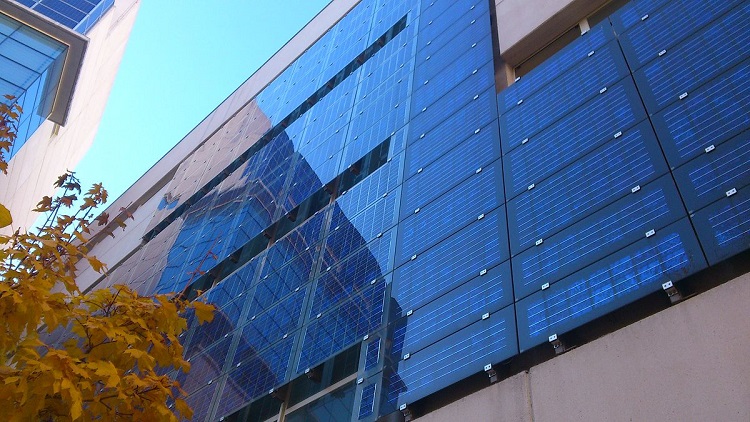 PV solar facade on a municipal building in Madrid, Spain. Source: Hanjin/Wikipedia
Building-integrated photovoltaics (PV) fundamentally represents a revolutionary method of building and energy conversion. It incorporates solar technology into the structure of buildings, transforming them into active participants in the renewable energy sector. This collaboration between architectural design and solar energy production not only meets the increasing demand for sustainable construction methods but also offers an innovative solution to the issues associated with conventional energy sources.
Comparison with standard PV systems
Building-integrated PV systems are electrically identical to "standard" PV systems. Because of the specific limitations imposed by man-made structures, the electrical performance of a building-integrated PV system may differ greatly from that of a conventional PV system. Notable distinctions include increased module temperatures caused by a lack of rear ventilation, sensitivity to partial shadowing and erratic irradiance patterns caused by neighboring objects or reflections. Both high and low tilt angles have the potential to influence soiling losses and angle-dependent losses. Aiming to minimize power losses connected with the specific conditions found in building-integrated PV system installations, architects should combine architectural restrictions with electrical efficiency.
Designing a building-integrated PV system
Since solar irradiance is not uniform across all of the building-integrated PV modules, and partial shade occurs more often than in traditional ground-mounted or rooftop PV systems, this is one of the primary limitations that designers must take into account when creating these building-integrated systems. Although shading losses are typically higher and influenced by the electrical architecture of the PV modules and PV system, it is commonly believed that power loss from partial shading is directly proportional to the shadowed area of the PV generator over time.
In addition to reducing power output, poorly planned systems can harm PV modules from localized overheating (hotspot generation) caused by partial shade in high irradiance. To mitigate or eliminate the partial-shading effect, designers of building-integrated PV modules and systems have come up with a number of solutions. These include adding dummy cells to areas where shading is anticipated or raising the perimeter margin surrounding cells in the modules to shield them from the mounting structure or frame. Because many building-integrated PV systems experience partial shading of the PV modules' active sections, it is necessary to tailor the system's electrical architecture to address this issue.
Shaded cells can be reverse-biased and drain power from the rest of the string under certain unsavory circumstances. Every module has a bypass diode that can short circuit an entire module or one of its substrings in order to prevent these hotspots. For crystalline silicon cells, for instance, one bypass diode is usually used to protect sub-strings of 20 to 24 cells. These bypass diodes need to be carefully selected to guarantee a long lifetime even under frequent partial shading conditions, since partial shading happens more often in many building-integrated PV systems compared to ground-mounted systems.
Electrical and fire safety
A key component of electrical safety for PV modules — and specifically for building integrated components — is the elimination of any potential danger to humans from design, construction, environmental, or operational flaws that could cause shock or injury upon contact with the PV modules' electrically live components. Methods for evaluating and avoiding such dangers are detailed in the applicable standard, IEC 61730-2. The accessibility, insulation and wet leakage current tests are all part of the electrical shock hazard testing protocol.
In addition, building-integrated PV systems are compliant with the international standard for low-voltage electrical installations, IEC 60364. Part one covers the basic safety concepts; part two covers the selection and installation of safe electrical equipment; and part three covers safety verification and functional considerations. Solar PV power supply systems and electric vehicle power supplies are examples of specific installations or locations that are also addressed.
When designing solar building envelopes, fire safety must be a top priority. Using PV modules as a substitute for traditional building materials must not compromise the safety of building occupants and firemen, nor should it compromise the structural integrity of the structures themselves. Nevertheless, present building standards and regulations do not adequately address the fire safety of PV installations in buildings. The fire safety requirements are addressed to varied degrees on a national basis. Building codes in different nations outline how building-integrated PV façades must react in the event of a fire, with the full system being tested in its actual setting. On the other hand, most building-integrated PV products on the market now just meet IEC requirements and might not have been through thorough system-scale fire testing.
Conclusion
Building-integrated PV presents a viable solution to diminish our dependence on traditional energy sources, predominantly reliant on fossil fuels, hence promoting a more sustainable and environmentally friendly built environment. Integrating solar technology into architectural features requires a sophisticated comprehension of both architecture and PV. Achieving a balance between the aesthetic and functional elements of building-integrated PV installations, while enhancing their performance, necessitates adept collaboration among technical proficiency, design creativity and a thorough understanding of the specific issues posed by each project.