Stellarator designed to advance fusion power
S. Himmelstein | March 14, 2025A new quasi-isodynamic (QI) stellarator configuration that harnesses the high-field potential of high-temperature superconductor (HTS) magnets is being advanced by Germany-based Proxima Fusion.
Researchers from the Max Planck Institute for Plasma Physics (Germany), Instituto de Plasmas e Fusão Nuclear (Portugal), University of Wisconsin-Madison and Karlsruhe Institute of Technology also contributed to the integrated concept for a commercial fusion power plant designed to operate reliably and continuously.
The QI stellarator-based Stellaris system is reportedly both smaller and more powerful than any stellarator power plant envisioned or realized to date. The much stronger magnetic fields that are enabled by HTS magnet technology allow for a significant reduction in size compared with previous stellarator concepts. Smaller reactors can be completed more quickly, deliver more efficient energy generation and will prove more cost-effective in both construction and operation. The Stellaris concept also relies on currently available materials and supply chains.
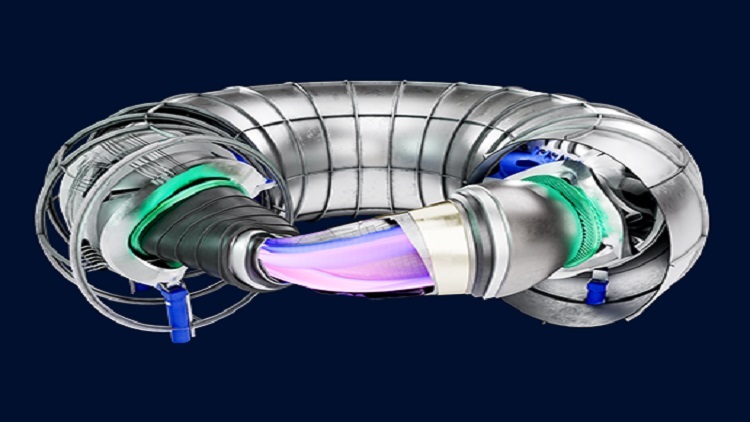 Source: Proxima Fusion
The design is intended to demonstrate that HTS technology can be effectively integrated in high field stellarators, while ensuring effective heat management on internal surfaces. The system includes a neutron blanket concept adapted to the complex geometry of stellarators.
The Stellaris design described in Fusion Engineering and Design provides a maximum of 2.7 GW of fusion energy, resulting in about 3.1 GW of thermal power for the plant. Proxima Fusion plans to demonstrate he energy production capability of this technology in 2031.