Behavior of CFRP During Flight Maneuvers Tested
By Engineering360 News Desk | March 21, 2016Researchers at the Fraunhofer Institute are testing the degree to which carbon fiber reinforced plastic (CFRP) parts deform during flight—knowledge essential to ensuring the safety of planes made from the lightweight material.
Their test aircraft was a medium-range plane, with capacity for 70 passengers, incorporating a five-by-three-meter-long CFRP component that formed the upper fuselage from the cockpit to the wings. This area is one of the most heavily stressed components during flight.
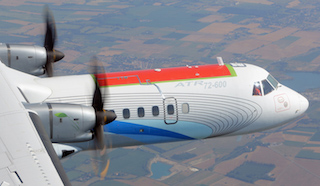 A five-by-three-meter-long CFRP component in the upper fuselage was tested. Image credit: Alenia Aermacchi.Due to the lower air pressure, a fuselage expands in flight. CFRP tolerates stretching of up to 1.5% of its original length before breaking. While the researchers knew that the component would withstand the stress of the test flight, they had not yet determined the degree to which it would deform during different flight maneuvers.
"CFRP structures behave differently during a flight to those made of aluminum," says Conchin Contell Asins, scientist at the Fraunhofer Institute for Structural Durability and System Reliability LBF, in Darmstadt.
She and colleague Oliver Schwarzhaupt determined exactly how differently they behave with the help of fiber-optic technology during the test flights. Using optical measuring fibers, the researchers were able to detect even minimal deformations in a way that‘s not possible with conventional metallic strain gauges.
The aim of the measurement flights was to obtain solid data that can be compared with the theoretical calculations of the flight behavior of CFRP. Because such data have been only approximated, manufacturers integrating CFRP are over-dimensioning in new models as a precaution.
"The test flights have shown that our test setup works: we have been able to assign a unique CFRP deformation to each flight maneuver. The values were so accurate that conclusions could have also been reached about the flight profile based upon the strain signals," Schwarzhaupt says.
For the test flight, the researchers applied the optical measuring fibers on the side of the CFRP component facing the aircraft interior. To attach the strain sensors to the right places, the researchers had to know where stress typically occurs during flight maneuvers.
In CFRP structures in aircraft, the attached stiffeners primarily bear the stress. These are located on the inside of the hull in the longitudinal and circumferential directions of the fuselage.
An optical-electrical evaluation unit recorded the signals of the measuring fibers—changes as small as a few nanometers—while the plane's black box provided information about the altitude, airspeed and flight maneuvers. The researchers correlated both data pools—strain measurements and flight data—to arrive at a detailed assessment of the CFRP's deformation during various flight maneuvers.
The researchers next plan to test CFRP's performance in an aircraft fuselage while on the ground and subject to increased internal cabin pressure.