Nanomaterial designed for use at crime scenes without a lab
Marie Donlon | September 25, 2024A team of researchers from Diamond’s labSAXS has created a fluorescent nanoparticle for detecting latent (non-visible) fingermarks.
To create the new fluorescent nanoparticle, researchers used a combination of materials including MCM-41, chitosan and dansylglyci, which together produced nanoparticles featuring special properties that make them adhere well to fingerprint residues — even old fingerprints.
To create the new fluorescent nanoparticle, researchers used a combination of materials including MCM-41, chitosan and dansylglyci, which together produced nanoparticles featuring special properties that make them adhere well to fingerprint residues — even old fingerprints.
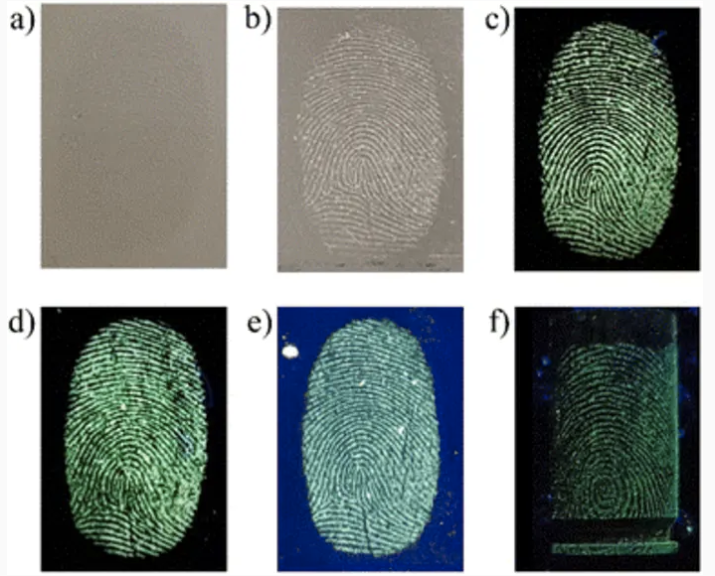 Representative images on stainless steel are shown, illuminated by and viewed under visible light (a) before development and (b) after development with MCM-41@Ch@DnsGly NPs. Corresponding images generated by illumination with UV light (λex = 365 nm) after MCM-41@Ch@DnsGly NP development are shown on (c) stainless steel, (d) glass, (e) plastic and (f) unfired brass cartridge case substrates. Source: RSC Advances
The researchers suggest that the nanoparticles can work on a variety of surfaces, including metal, plastic and glass, as well as on complex objects. Likewise, the nanoparticles can potentially be used directly at crime scenes without the need for lab facilities. This is because the particles reportedly produce high-quality fingerprint images, capturing the finer details of a fingermark, which makes it easier to identify individuals and to aid in forensic investigations.
“There are few studies employing chitosan for detection and enhancement of latent fingerprints and, to the best of our knowledge, no reports of the use of hierarchically structured MSNs modified with chitosan (MSN@Ch) for such applications — which was our strategy in this research. We exploited the MCM’s desirable characteristics — notably high surface area and surface modification — for the case of MCM-41 to enhance the interaction between the development reagent and fingerprint residue,” the researchers explained.
The result is the new nanostructured hybrid material, MCM-41@chitosan@dansylglycine, which combines mesoporous silica nanoparticles with a fluorescent dye (dansylglycine) and chitosan, which is a polysaccharide derived from the exoskeletons of shrimps, crabs and lobsters.
When trialed on a collection of marks deposited on chemically diverse surfaces and subject to complex environmental and temporal histories, the team found that the enhanced images offered sufficient minutiae for comparison with model dactyloscopy images.
An article detailing the nanoparticle, “Dansyl fluorophore functionalized hierarchically structured mesoporous silica nanoparticles as novel latent fingerprint development agents,” appears in the journal RSC Advances.
Powered by CR4, the Engineering Community
Discussion – 0 comments
By posting a comment you confirm that you have read and accept our Posting Rules and Terms of Use.