Microscope achieves attosecond resolution
S. Himmelstein | October 10, 2024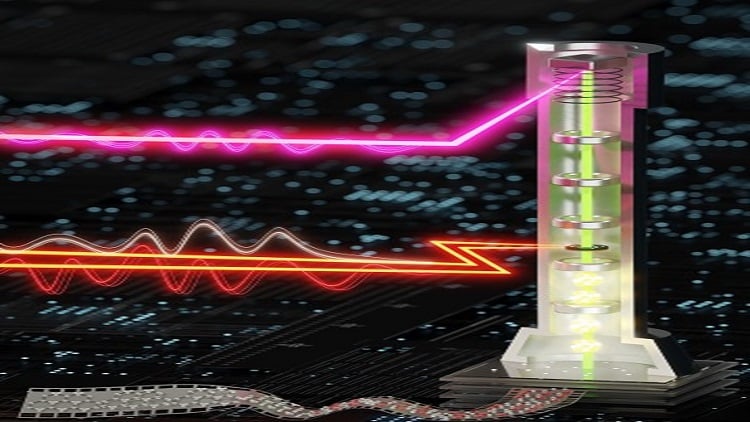 The laser (pink) sets off an ultrafast pulse of electrons (green) inside the device. A laser pulse is then split into two beams (orange) which hit the sample at slightly different times, triggering a one-attosecond electron pulse that can image a sample. Source: University of Arizona
Up until now, the most powerful transmission electron microscopes available could capture events on the scale of attoseconds, or quintillionths of a second. Greater speed in imaging has been achieved by University of Arizona researchers with the development of a microscopy system that can generate images representing events lasting just one quintillionth of a second.
The ultrafast microscope described in Science Advances splits and converts a powerful laser into two ultrashort light pulses. A pump pulse directs energy to a sample to foster electron movement while an optical grating pulse provides opportunity for the generation of a gated, single attosecond electron pulse. The speed of the gating pulse dictates the resolution of the image, and by synchronizing the two pulses, analysts can control when the electron pulses probe a sample to observe ultrafast processes at the atomic level.
The technology was successfully applied to the analysis and documentation of attosecond time-resolved electron diffraction measurements of graphene. Findings show a strong correlation between field-induced electron dynamics in the conduction band and the real space electron motion between the carbon atoms in graphene.
Attosecond electron microscopy could find application in drug discovery, quantum physics, materials science and other fields.