Understanding the pH electrode
Sakshi Jadhav, courtesy of Mettler Toledo | July 26, 2024 Source: Mettler Toledo
Measuring pH is a significant process used in many scientific, industrial and medical applications. The pH electrode is a crucial component in pH measurement, providing a direct and accurate assessment of the acidity or basicity of a sample. It is a specialized sensor used to analyze the potential difference generated by the presence of H+ ions in the solution. Therefore, it is an essential tool in chemistry, biology, environmental science and various industries where pH monitoring is important.
The pH electrode is responsible for sensing the pH in a solution. It contains a glass shaft with a thin glass membrane at the end, sensitive to H+ ions. When the membrane encounters an aqueous solution, a gel layer forms on the outside of the membrane glass. A similar gel layer forms inside the membrane glass due to the inner aqueous electrolyte solution in the electrode. The H+ ions in and around the gel layer can either diffuse into or out of this layer, depending on the pH value and H+ ion activity of the measured solution. If the solution is alkaline, the H+ ions diffuse out of the layer, creating a negative charge on the outer side of the membrane. Since the glass electrode has an internal buffer with a constant pH value, the potential on the inner surface of the membrane remains constant during the measurement. Therefore, the pH electrode potential is the difference between the inner and outer charge of the membrane.
The reference electrode on the other hand does not respond to the H+ ion activity in the sample solution and will therefore always produce the same, constant potential against which the pH sensor potential is measured. It must also be open to the sample environment into which it is dipped. To achieve this, an opening or junction is made in the shaft of the reference electrode through which the inner solution or reference electrolyte can flow out of the sample. The reference electrode and pH half-cell must be in the same solution for correct measurements. The construction of the electrode is such that the internal reference element is immersed in a defined reference buffer and is indirectly in contact with the sample solution via the junction. This contact chain ensures a stable potential. The reference electrolyte must have a high ion concentration resulting in a low electrical resistance. Since the reference electrolyte flows into the sample solution during measurement, one should be aware of any possible reactions between the reference electrolyte and the sample solution, as this can affect the electrode and measurement. The potential difference between these two electrodes determines the pH value of the measured solution. Therefore, pH is a measure of hydrogen ions' activity in the solution. This potential is a linear function of the hydrogen ion activity in the solution, which allows quantitative measurements to be made.
The formula for this function is given as,
E = E0 + 2.3RT / nF * log [aH+]
[aH+] = Activity of H+ ions
E = Measured potential
E0 = Constant
R = Gas constant
T = Temperature in degrees Kelvin
n = Ionic charge
F = Faraday constant
 Source: Mettler Toledo
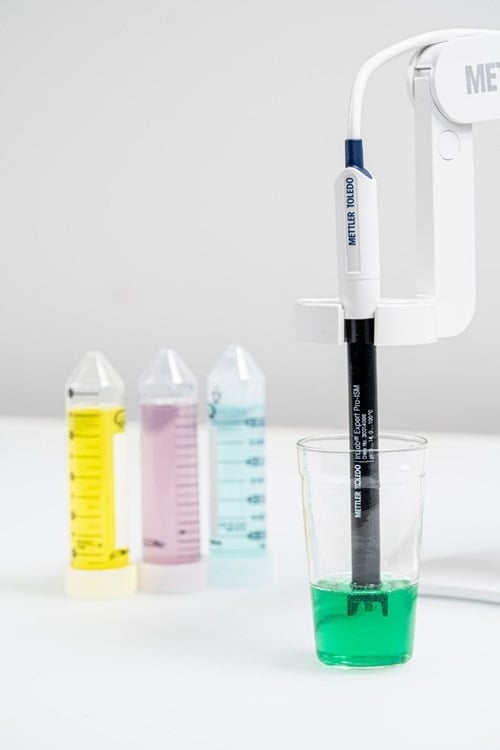
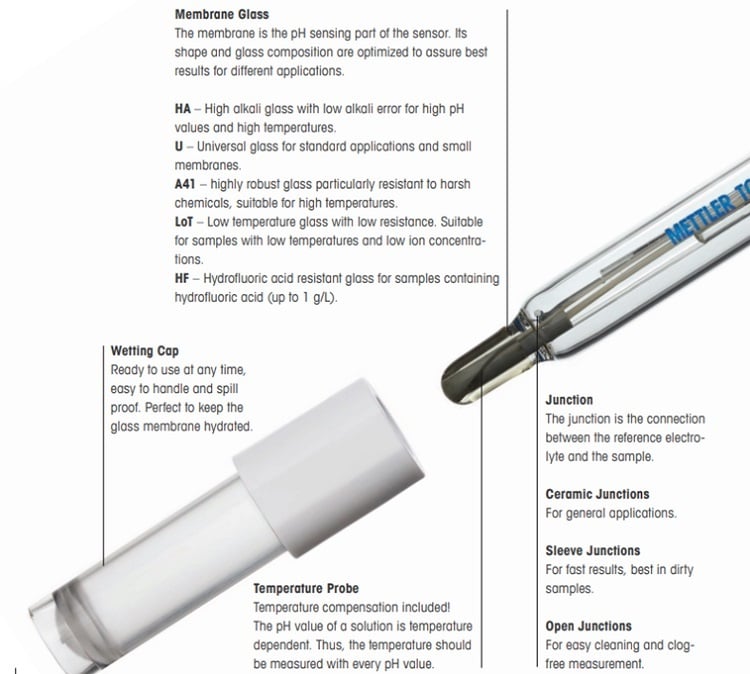
Nowadays, a merger of two separate sensors into one electrode is very common and this combination of reference and pH electrodes is called the combined pH electrode. Combined electrodes are much easier to handle than two separate electrodes and are commonly used today. In the combined electrode, the pH-sensitive glass electrode is surrounded by the reference electrode filled with reference electrolyte in a concentric manner. The separate pH and reference parts of the combined electrode have the same properties as the separate electrodes; the only difference is that they are combined into one electrode for ease of use. Only when the two components of the combined electrode are expected to have very different life expectancies is the use of individual pH and reference electrodes recommended rather than a single combined electrode. To simplify pH measurements, a temperature sensor is incorporated in the same body as the pH and reference elements. This allows temperature-compensated measurements to be made. Such electrodes are also called 3-in-1 electrodes.
 Source: Mettler Toledo
Mettler Toledo has built up an enormous treasure trove of experience and knowledge over the last decades resulting in a complete sensor portfolio that supports any applications. Right from the membrane glass and junction of various types to the elements like safelock and wetting cap, these sensors can help achieve trust, ease and reliability throughout pH measurements.
To learn more about the sensors and their characteristic features, head to the InLab Sensors — Product Brochure. Customers can also visit the company website for the right pH tool for their applications.
To contact the author of this article, email pHmatters@mt.com