A nuclear option for clean district heating
S. Himmelstein | August 26, 2024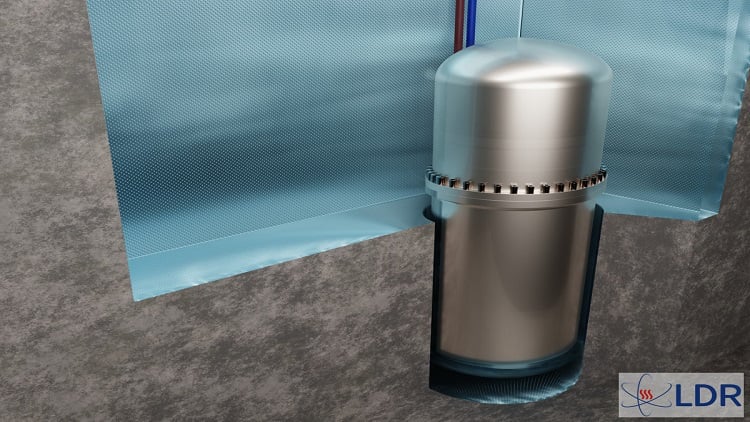 A reactor module submerged in a pool of water, which acts as a heat sink. The dimensions of the outer containment vessel are comparable to the size of an upright city bus. Source: VTT Technical Research Centre of Finland
The more than 3,000 local district heating networks that warm homes of 60 million people throughout Europe are major sources of carbon dioxide (CO2) emissions. A small modular reactor is under development by Steady Energy, a spinoff of VTT Technical Research Centre of Finland, as a more environmentally sustainable source for district heat production and low-temperature industrial applications.
The carbon footprint and other environmental aspects of the LDR (low-temperature district heating reactor)-50 small modular unit lifecycle were examined by VTT researchers. A standard life cycle analysis methodology was applied to assess the energy and material streams of the different phases of the life cycle, together with the associated emissions.
The specific emissions for heat produced by the nuclear heating plant, which delivers a thermal output of 50 MW, were estimated to be 2.4 g CO2/kWh, considerably lower than that for natural gas (282 g CO2/kWh and coal (515 g CO2/kWh), respectively. The carbon footprint of the nuclear option proves comparable to heating with heat pumps in countries with a clean electricity mix, such as Sweden and France, and significantly lower when compared to grids with a large share of fossil production, including Poland and Germany.
[See also: A modular nuclear approach to decarbonize district heating]
Analysis of other life cycle impacts, including those pertaining to land use, water quality and human toxicity, indicate that the adverse environmental impacts for the LDR-50 reactor are low compared to other heating fuels.
The environmental advantages of the reactor technology stem from the high energy density of the uranium consumed compared to combustible fuels. A reactor fuel assembly contains 126 kg of enriched uranium, which produces as much energy as six million liters, or 30,000 barrels, of heating oil.
The study published in Energies shows that nuclear energy can become a viable option for replacing fossil fuels in heat production.