
Video: A modular nuclear approach to decarbonize district heating
S. Himmelstein | July 27, 2023In pursuit of its goal to decarbonize the energy-intensive heating industry, nuclear startup Steady Energy plans to build the world’s first low-temperature district heating reactor (LDR) plant by 2030.
The small modular reactor is being developed by the spin-out company from VTT Technical Research Centre of Finland with a thermal output of 50 MW and operating temperature of about 150° C. Safety is assured by operating at a pressure below 10 bar (145 psi), considerably lower than of a district heating network and ensuring quick containment of potential leaks.
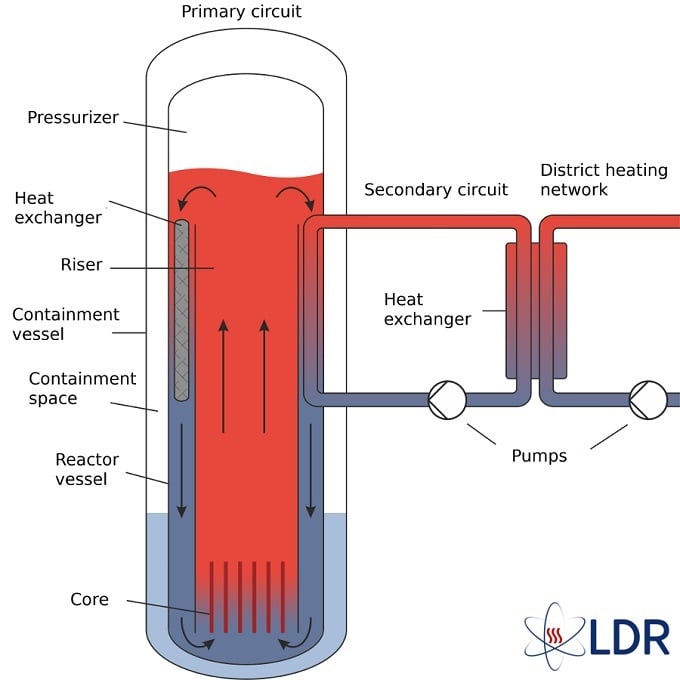 Schematic of the LDR-50 reactor design. Source: VTT Technical Research Centre of Finland
The system is designed as two nested pressure vessels separated by water, which begins to boil when heat removal through the primary heat exchangers is compromised. This scheme provides an efficient passive heat transfer route into the reactor pool without the need for mechanical moving parts, which could fail and prevent the cooling function.
One LDR-50 is sufficient for supplying district heating needs for a small city and displacing fossil fuel-based heating networks. These units are also envisioned to support desalination plants to produce fresh water or to generate steam for industrial purposes.

I'd rather use the nuclear reactor to generate electric power with a steam turbine then use the waste heat from the condenser for low-grade heat for district heating/domestic hot water. But, people don't like power plants right in their city, which is really too bad because so much heat from the steam process is just rejected directly into the environment (water cooling, water assisted air cooling, etc.).
Its amazing how all nuclear power projects reports always leave out the storage of accumulated spent rods.
Consider changing your nuclear reactor to the Gen IV, fast neutron, type; there is no water used and therefore no pressure is required. It is also much more efficient.
In reply to #3
And no more spent rods to store.
In reply to #4
Wrong. There are still fuel elements that should be reprocessed, but the quantity and intensity of the radioactivity is much less.