Solar cells for electric vehicles
S. Himmelstein | July 12, 2024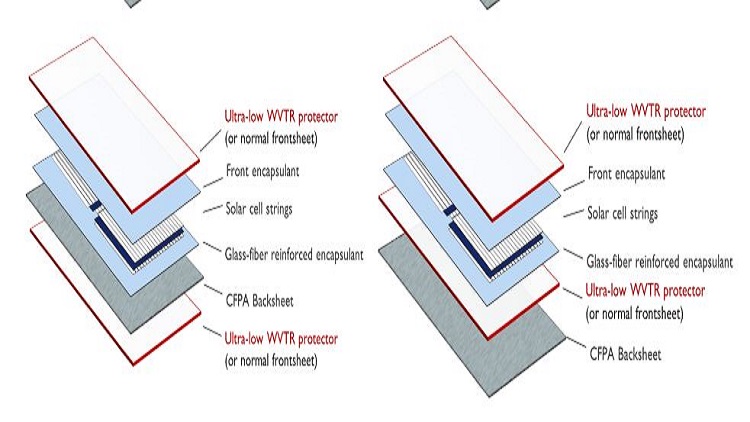 Source: Imec
Vehicle-integrated photovoltaic (VIPV) components offer a route to extend the driving range of electric vehicles (EVs). Inclusion of such modules on the vehicle hood, roof and body panels will require the use of light-weight materials to design weather-resistant and reliable solar cells.
A European research team reports progress toward these goal after evaluating interconnection and encapsulation strategies to improve VIPV module reliability against damp heat and mechanical impacts. Tests were conducted with lightweight mini modules weighing around 3.45 kg/m2 and using backsheets reinforced with either glass-fiber polypropylene or carbon-fiber polypropylene. The back encapsulant was composed of polyolefin elastomer (POE) reinforced with randomly oriented short glass fibers in an 8.2% weight ratio. The solar structures also include multi-wire connected heterojunction cell strings, a thermoplastic polyolefin contact foil, a front encapsulant made of POE and a polyethylene terephthalate front sheet.
During mechanical impact tests, use of a backsheet with a higher bending stiffness was observed to reduce global bending and shear stresses, preventing cell cracks. The results of damp heat tests led to a design that includes carbon-fiber polyamide backsheets and new low-moisture transmission layers in the module. These design decisions increased the weight to 5.21 kg/m2 as well as the cost, but the strategy enabled increased resilience to earlier observed failure modes.
Researchers from KU Leuven (Belgium), Imec (Belgium), Hasselt University (Belgium), EnergyVille (Belgium), EPFL-PV Lab, (Switzerland) and OFI-Austrian Research Institute for Chemistry and Technology (Austria) contributed to this study, which is published in Solar Energy Materials and Solar Cells.