Voltage Barrier Broken for CdTe Solar Cells
Engineering360 News Desk | March 04, 2016A low-cost alternative to the silicon solar cell is cadmium telluride, which offers one of the lowest carbon footprints in solar technology and outperforms silicon in hot, humid weather and under low light. However, until recently, CdTe cells haven’t been as efficient as silicon cells. Researchers for the past 60 years were not able to get more than 900 millivolts out of the material, which was considered its practical limit.
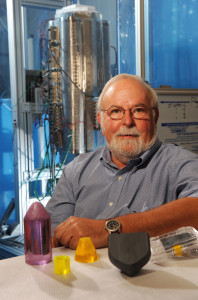 WSU’s Kelvin Lynn with crystals made in his lab. Image source: WSU One area where CdTe has underperformed is the maximum voltage available from the solar cell, called open-circuit voltage. Now, researchers from U.S. Department of Energy’s National Renewable Energy Laboratory (NREL), Washington State University, and University of Tennessee have improved the CdTe conductivity and carrier lifetime by orders of magnitude, enabling fabrication of CdTe solar cells with an open-circuit voltage breaking the 1-volt barrier for the first time.
The research team improved cell voltage by shifting from a standard processing step using cadmium chloride to placing a small number of phosphorus atoms on tellurium lattice sites and then forming ideal interfaces between materials with different atomic spacing to complete the solar cell.
Crystals are grown in a technique called melt growth, which allows precise control over purity and composition. Purity is critical to the process, so the researchers mix, prepare, and vacuum-seal the materials in an industry-standard clean room.
They then synthesize the crystal in a furnace above 1100 degrees° C and cool it from the bottom up at a rate of about one millimeter per hour. The crystal is cut into polished wafers to make the solar cells.