Environmental Risks of Carbon-Removal Schemes Unclear
By Engineering360 News Desk | March 02, 2016Emissions reduction is likely to be less expensive and more effective than carbon-removal schemes, which may pose environmental risks, according to an environmental scientist at the University of East Anglia (UEA), in Norwich, UK.
The carbon sequestration methods put forward to date include: growing crops to be burned in power stations, large-scale tree plantations, adding biochar to soil, adding nutrients to sea water to boost plankton and seaweed, and using chemicals to extract CO2 from the atmosphere and bury it underground.
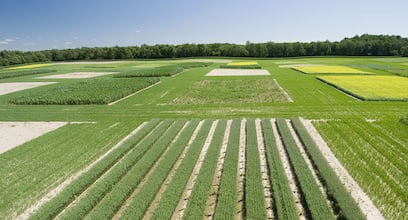 Bioenergy crops required for power plant fuel could occupy 580 million hectares of land. Image credit: DOE/BERIS.But in a comment piece published in Nature, Dr. Phil Williamson, of UEA’s School of Environmental Sciences, argues that most, if not all, of these methods pose environmental risks. Much more research is needed before the wheels are set in motion on global-scale "climate geoengineering" schemes, he cautions.
According to Williamson, climate modelers estimate that as much as 600,000 million metric tons of CO2 may need to be extracted from the atmosphere by 2100 to deliver the main goal of the Paris agreement.
“If rapid cuts are not made, then significant CO2 removal will need to begin in less than four years—with up to 20,000 million tons removed each year by 2100 to keep the global temperature increase well below 2 degrees Celsius," Williamson writes. “But removal will be expensive—and is currently unproven at the scale needed—so it would be much better to reduce emissions as rapidly as possible.”
Large-scale CO2 removal by any means will have flow-on effects for ecosystems and biodiversity, Williamson says. "There could be benefits, but damage seems more likely."
As an example, he cites the carbon sequestration method of growing bioenergy crops to be used as fuel in power stations, with the resulting CO2 captured for long-term storage underground. "The amount of bioenergy crops we would need to grow could use up to 580 million hectares of land—or half of the land area of the U.S. This would, in turn, accelerate the loss of forests and natural grassland with impacts for wildlife, whilst also having implications for food security," he writes.
Very little is known about the effect of future climatic conditions on the yields of bioenergy crops, Williamson adds—for example, the water requirements of these crops in a warmer world.
“It’s also important to think about the financial costs of these ideas. For example, adding enough crushed silicate rocks to the soil over almost half of the Earth’s land surface could cost up to $600 trillion," he writes.
Governments and other funding agencies need to invest in research to investigate the viability and safety of the "emit now, remove later" approach, Williamson says. "Present climate policy assumes that one or more of them will work at the scale required, yet we just don’t know if that is the case,” he concludes.