Stepper motors and their applications
N. Mughees | April 23, 2024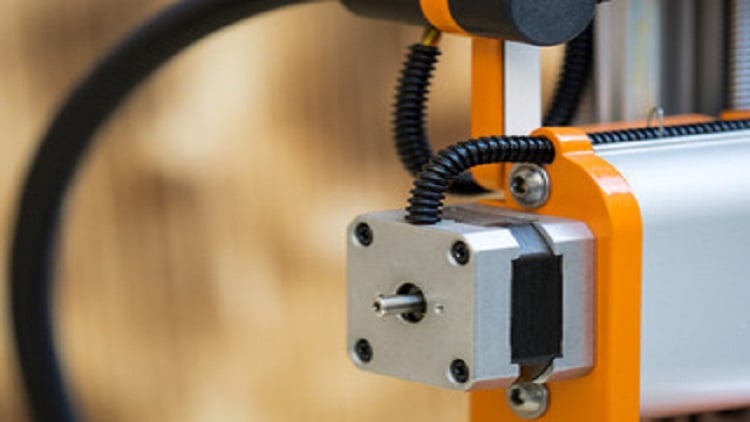 Stepper motor on a CNC desktop machine. Source: Teodor Costachioiu/Adobe stock
Stepper motors have their roots in the invention of stepping relays in the early 1900s; however, no one knows for sure where they originated. In the 1920s, the first modern stepper motor appeared, and thanks to developments in automation and control systems, it acquired considerable traction in the second half of the twentieth century. The capacity to accurately manipulate angular position and rotation gives them a distinct advantage. The precise control and placement made possible by stepper motors is attributed to their discrete steps, as opposed to the continuous spinning of conventional DC motors.
How they work
The two primary components of a stepper motor are the rotor and the stator, which house the electromagnets, or coils, that cause the motor to spin. The rotor is made to spin in steps by deliberately energizing these coils in a certain order, which is done by means of the motor's magnetic field. Two critical design parameters determine the step angle and the number of steps required to complete one full rotation:
1. Number of teeth: Both the rotor and stator have teeth. The number of teeth on the rotor plays a crucial role in determining the number of steps per full rotation. As an example, consider a motor with 200 teeth on the rotor. To complete one full rotation, the rotor needs to align with each tooth on the stator. This results in 200 steps per full rotation.
2. Pole count: Each tooth on the rotor and stator contributes to a pole. A pole refers to a single north or south magnetic pole on the rotor or stator. The total number of poles on the rotor and stator combined is called the pole count.
Advantages and disadvantages
Compared to other motors, stepper motors offer distinct advantages:
• Precise positioning: Unlike DC motors, stepper motors offer precise control over their position, eliminating the need for additional feedback mechanisms.
• Simple control: Controlling stepper motors is relatively straightforward, often requiring just a pulse train to dictate the number of steps and direction.
• Holding torque: Stepper motors can maintain their position even when not actively rotating, unlike DC motors that require continuous power to hold their position.
However, stepper motors also have some limitations:
• Lower speed: They generally operate at slower speeds compared to DC motors.
• Resonance: They can be susceptible to vibrations and resonance at certain speeds, impacting their performance.
• Complexity: While control is simpler than some motors, they still require specialized driver circuits for proper operation.
Applications
Stepper motors find themselves in various applications across diverse industries:
• Manufacturing and robotics: 3D printers, CNC machines, pick-and-place robots and automated assembly lines. For instance, stepper motors control the movement of the print head along the X and Y axes in 3D printers. By precisely moving the print head in small increments, the motor dictates the path of the extruded filament, building the desired 3D object layer by layer. Additionally, some 3D printers may employ stepper motors to control the Z-axis movement, raising and lowering the print head for different layers.
• Office automation: Printers, scanners and disk drives.
• Medical devices: Blood pumps, surgical robots and diagnostic equipment. For example, stepper motors are embedded in robotic arms and instruments, enabling precise manipulation and controlled movement during minimally invasive surgeries. This allows surgeons to perform complex procedures with greater accuracy and dexterity than traditional techniques. Additionally, stepper motors can be used in the camera positioning system of surgical robots, providing surgeons with clear and stable visuals of the surgical field.
• Security systems: CCTV cameras, access control systems and automated gates.
• Consumer electronics: Floppy disk drives, DVD players and camera lenses.
A stepper motor is ideal for such applications because of:
• High precision: 3D printers, CNC machines, robotic arms and disk drives rely on stepper motors for precise movement and positioning.
• Controlled movement: Cameras, security systems and automated assembly lines utilize stepper motors for controlled rotations and precise stopping points.
• Holding torque: Even when stationary, stepper motors can maintain their position without additional mechanisms, making them suitable for applications like holding doors open or positioning antennas.
Conclusion
With their unique combination of precision, control and holding torque, stepper motors continue to play a vital role in various applications demanding precise and controlled movement. However, it is also important to note that stepper motors have been replaced by other motor technologies (like voice coil motors in cameras) in many modern applications due to their limitations in speed and smoothness compared to newer options. However, their historical contribution to these devices remains noteworthy, and they continue to find use in specific scenarios where their unique characteristics are advantageous.