Copper Deposition Used to Fabricate Tiny 3D Objects
Engineering360 News Desk | February 25, 2016A new 3D microprinting process allows scientists to manufacture tiny, complex and even partly overhanging metal components in a single step.
In most existing 3D microprinting processes, overhanging structures can be achieved only through a workaround: during the printing process, a stencil manufactured beforehand is used as a placeholder under the overhang that is to be printed. The template must be removed once printing is complete.
In the new technique developed by Zurich ETH doctoral student Luca Hirt of the Laboratory of Biosensors and Bioelectronics, the print head can also print sideways. This means that overhangs can be printed without templates.
The new technique is a refinement of the FluidFM system developed at ETH Zurich several years ago, at the heart of which is a moveable micropipette mounted on a leaf spring that can be positioned with precision. Nowadays, FluidFM is used primarily in biological research and medicine—for example, to sort and analyze cells and to inject substances into individual cells.
Hirt investigated the possibility of using FluidFM for printing processes—in particular, to electro-deposit dissolved metals and other substances on to a conductive substrate.
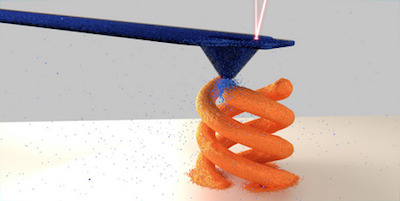 ETH researchers use a movable micropipette (blue) to manufacture tiny copper objects. Image credit: ETH Zurich/Alain Reiser.The system he developed starts with a droplet of liquid that is placed on a base plate made of gold. The tip of the micropipette penetrates the droplet and acts as a print head. A copper sulphate solution flows through the pipette. Using an electrode, scientists apply a voltage between the droplet and the substrate, causing a chemical reaction under the pipette aperture. The copper sulphate emerging from the pipette reacts to form solid copper, which is deposited on the base plate as a tiny 3D pixel.
Using a computer to control the movement of the micropipette, researchers can print three-dimensional objects pixel by pixel and layer by layer. At present, the scientists can produce individual 3D pixels with diameters ranging from 800 nanometers to more than five micrometers and can combine these to form larger 3D objects.
“This method can be used to print not only copper but also other metals,” says Tomaso Zambelli, associate lecturer and group leader in the Laboratory of Biosensors and Bioelectronics at ETH Zurich. FluidFM may even be suitable for 3D printing with polymers and composite materials, he says.
ETH spinoff Cytosurge has licensed the method from ETH Zurich. “Now, the task is to optimize this application in collaboration with interested researchers at universities and in industry—for example, in the watchmaking, medical technology and automotive sectors,” says Pascal Behr, CEO of Cytosurge. He sees an initial application in the field of rapid prototyping, in which microscopic components can be manufactured quickly using 3D printing.