Printed solar cells soar into space
S. Himmelstein | March 06, 2024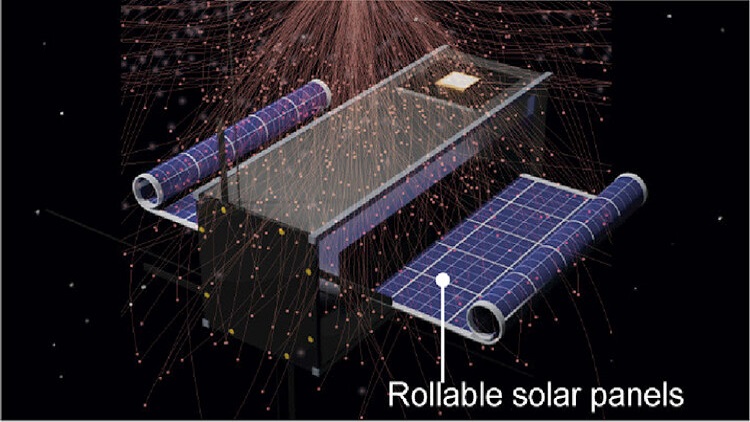 CSIRO is exploring the potential of printed flexible solar cells as a reliable energy source for future space missions. Source: ACS Appl. Energy Mater. 2024/10.1021/acsaem.3c02761
Flexible solar cells developed and printed by Australia’s Commonwealth Scientific and Industrial Research Organization (CSIRO) launched into space on March 5, 2024, aboard Optimus-1 as part of 53 Space X’s Transporter-10 rideshare mission l from Vandenberg Space Force Base, California.
This mission will test the eight photovoltaic modules attached to the surface of Space Machine Company’s satellite as a potentially reliable, lightweight energy solution for future space operations. The flexible perovskite-based solar cells are expected to provide a highly portable more radiation-tolerant alternative to conventional silicon-based solar cells. The researchers also expect the perovskite modules to outperform traditional cells when sunlight hits them at non-optimal angles during low-Earth orbit.
Earth-bound simulation studies described in ACS Applied Energy Materials confirm that the printed panels based on triple-cation perovskite and 2D perovskite slab compositions are at least as tolerant to proton and electron radiation as glass-based control devices.