ESA Launches First Phase of "Space Data Highway"
By Engineering360 News Desk | February 24, 2016The European Space Agency (ESA) has launched development of a communication network that will use laser technology to dramatically increase the speed of data transmission from satellites to users on the ground.
The first node of the European Data Relay System (EDRS) project, EDRS-A, was guided late last month into its final geostationary position at 9°E over Europe, where it will be operated by France-based satellite provider Eutelsat.
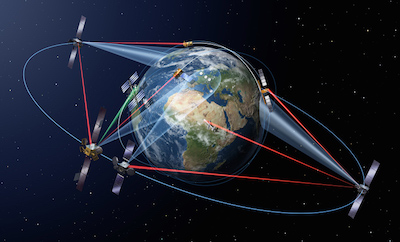 The first node of the EDRS project has been guided into its final geostationary position at 9°E over Europe, where it will be operated by France-based Eutelsat. Image credit: ESA.Dubbed the "Space Data Highway," ESA says the EDRS—a public-private partnership between ESA and Airbus Defence and Space, based in Ottobrunn, Germany—will revolutionize satellite communications as Europe’s first optical communication network, capable of relaying user data in near-real time at an unprecedented 1.8 Gbit/s.
Normally, low-orbiting satellites must come within view of a ground station before they can send their information to Earth. EDRS will instead collect their information from its higher geo-stationary position via laser and immediately relay it to the ground, dramatically improving access to time-critical and potentially life-saving data. ESA says improving access to such data could aid in the effectiveness of activities such as maritime surveillance and disaster response by emergency services.
Once fully deployed, EDRS will relay up to 50 terabytes of data from space to Earth every day. It will eliminate the downlink delay currently prohibiting immediate access to satellite information and ultimately allow for the phasing out of Europe’s reliance on overseas ground stations.
EDRS-A will begin relaying information this summer from its first customers: the ESA/European Commission Copernicus Sentinel-1 and -2 satellites. The second EDRS node, the dedicated EDRS-C satellite, will be launched in 2017 to join EDRS-A over Europe. A third is planned in 2020 over the Asia-Pacific region, doubling the system’s coverage.