New coating even more repellent to ice
Marie Donlon | March 10, 2024Researchers from Austria’s Graz University of Technology have fabricated an ice-repelling, abrasion resistant coating that sticks to several different materials.
To improve upon current ice-repellent coating iterations, which tend to be very sensitive and quickly detach from surfaces they are designed to protect, the team used manufacturing tech called initiated chemical vapor deposition (iCVD).
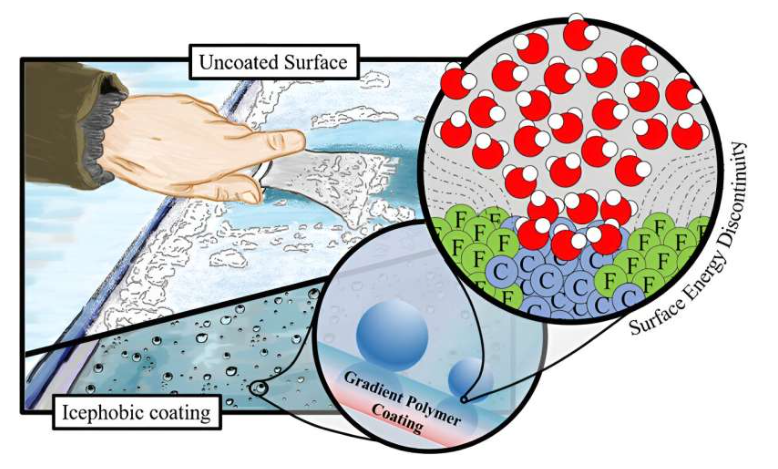 Graphical abstract. Source: ACS Applied Materials & Interfaces. DOI: 10.1021/acsami.3c18630
The iCVD process made it possible for a strong adhesive primer material to transition into an ice-repellent compound. This was accomplished by applying the two materials as a changing gas mixture to the surface to be coated. The researchers explained that the gas mixture initially consists entirely of the primer material. However, the concentration of the ice-repellent material is increased during application — gradually from 0 to 100% — resulting in a coating with a strong adhesive underside and a top side that deters ice crystals from clinging.
"The ice-repellent material consists of elongated molecules that adhere to the primer in a vertical or horizontal orientation," added the researchers. "The thicker we applied the material, the more random the alternation between vertical and horizontal molecules became. And the more random the arrangement at the surface, the greater the ice-repellent effect."
The researchers are eyeing the coating for the aviation industry to potentially expedite the de-icing of aircraft.
The team's paper, “Icephobic Gradient Polymer Coatings Deposited via iCVD: A Novel Approach for Icing Control and Mitigation,” appears in the journal ACS Applied Materials & Interfaces.