Sensor detects lead in water with unprecedented sensitivity
S. Himmelstein | March 07, 2024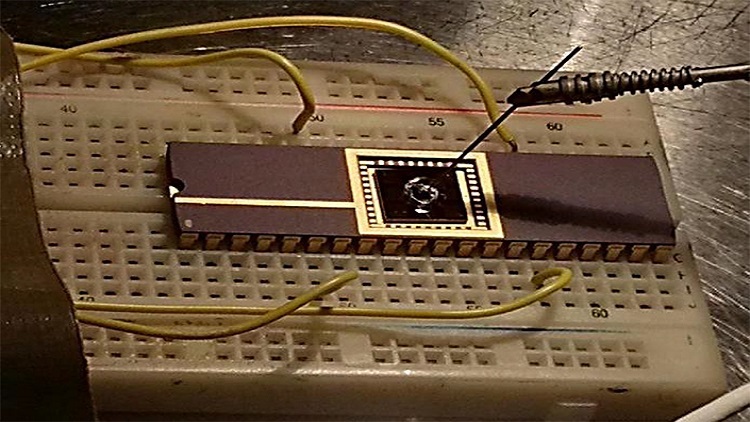 Experimental setup of the device detecting lead ions in a drop of water. Source: Bandaru Lab/University of California San Diego
A graphene-based sensor has been developed that is highly specific for detecting lead (Pb) ions. The device designed by researchers from the Keck Graduate Institute and the University of California San Diego achieves a record limit of Pb detection down to the femtomolar range, which is one million times more sensitive than available sensing tools.
The device comprises a single layer of graphene mounted on a silicon wafer. The sensing capabilities of this layer are enhanced by a linker molecule attached to its surface, functioning as the anchor for an ion receptor and specifically Pb ions. The binding affinity of the aptamer-based receptor for Pb ions was strengthened by tailoring its DNA or RNA sequence, ensuring that the sensor would only be activated in the presence of Pb. Binding energies, changes in capacitance and other thermodynamic parameters of the system were also examined and optimized.
The proof-of-concept sensor described in Nano Letters eliminates the use of high-cost instrumentation commonly required in traditional Pb testing protocols while providing a record limit of detection. The researchers will now scale up its production for commercial use.