Study: Resin destroys coronavirus on plastic surfaces
Marie Donlon | February 13, 2024A resin ingredient can reportedly decrease the infectivity of coronaviruses on plastic surfaces, according to a team of researchers at the University of Jyväskylä, Finland.
The researchers are attempting to develop anti-viral surfaces to decrease the spread of infectious diseases. On such surfaces, viruses can reportedly persist for long periods of time, thereby increasing the risk for infection. As such, the researchers are investigating how various surfaces and materials might reduce the spread of viral diseases.
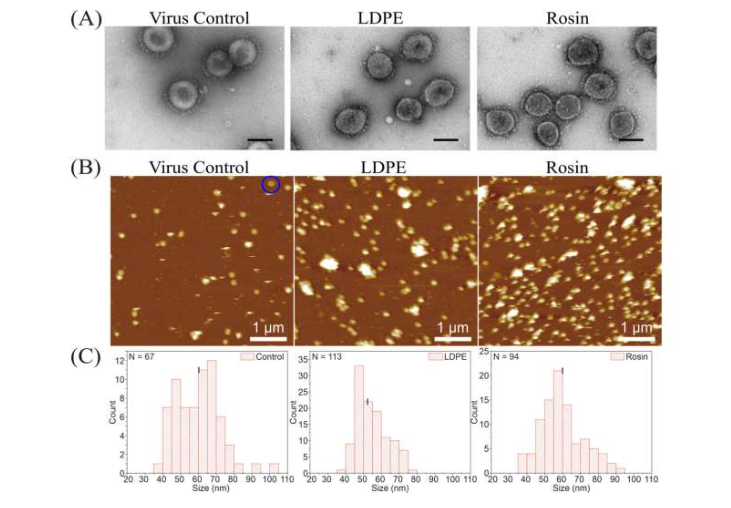 Studying the impact of rosin-functionalized plastic and standard LDPE on the structure of HCoV-OC43 using (A) TEM and (B) AFM in liquid. The scale bar corresponds to 100 nm and 1 µm in the TEM and AFM images, respectively. In panel B, the blue circle highlights a doughnut-shaped virus. (C) The histogram derived from the AFM images illustrates the average size distribution of the height of individual viruses after being flushed from their respective surfaces. Source: Microbiology Spectrum (2024). DOI: 10.1128/spectrum.03008-23
Specifically, the researchers examined the antiviral functionality of resin-embedded plastic surfaces against seasonal human coronavirus and the SARS-CoV-2 virus.
In the lab, the viruses remained infective for more than 48 hours on untreated plastic surfaces while a plastic surface treated with resin demonstrated antiviral activity within 15 minutes of contact and significantly improved efficacy after half an hour. As such, the researchers believe that plastic treated with resin is a promising candidate for antiviral surfaces.
The study was conducted as part of the BIOPROT project (Development of bio-based and antimicrobial materials and use as protective equipment).
An article detailing the findings, “Antiviral action of a functionalized plastic surface against human coronaviruses,” appears in the journal Microbiology Spectrum.