4 trends in additive manufacturing investment
Courtesy IMTS+ | January 19, 2024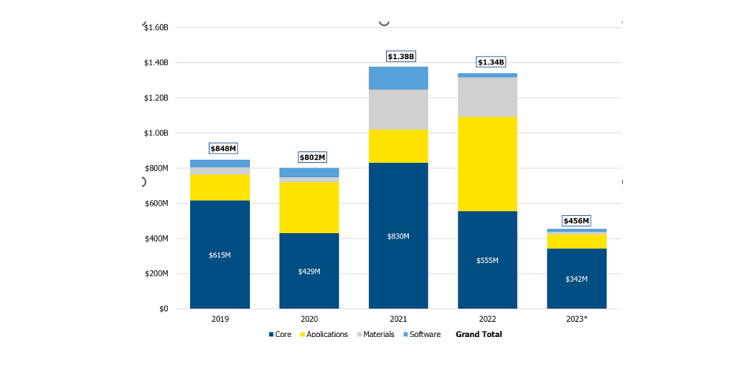 Source: IMTS+
Editor's note: This content appears here courtesy of IMTS+. Read the original here.
Additive manufacturing (AM) is a high-growth industry, with a double-digit growth rate of 14% to 15% year after year. AM represents just one of the industries and market verticals that was discussed at the MTForecast 2023 event, hosted by AMT — The Association for Manufacturing Technology. Following the money in high-growth industries continues to provide insights into its dynamics and near-term future.
Because of this, here are four trends happening in additive manufacturing investment.
1. High growth
The AM industry has grown from roughly $8.5 billion to nearly $14.5 billion between 2018 and 2022. This growth represents a compound annual growth rate (CAGR) of more than 14%. While $14.5 billion sounds like a large number for equipment, materials and services, AM still only represents a small portion of durable goods manufacturing overall. For comparison, global machine tool sales revenue alone was $85 billion in 2021. This is just the physical machines, and it is still six times larger than the total addressable AM market.
2. VC investment
Each venture capital investment can be sorted into four AMT-defined categories: core technology, applications, software and materials. Core technology, the investments that represent AM process development, have remained the primary focus for venture capital investment over the last five years. The year 2022 saw investments in 3D printing applications reach $536 million, three times the amount from 2021.
In contrast to the growth of recent years, total 2023 investment is projected to be down due to the broader economic factors and expectations. Higher interest rates and fears of recession have reduced the willingness to invest in AM. Currently, 2023 is projected to reach $570 million in venture investment into AM by year-end. The deal count is also lower, with a projected 55 in 2023, down from the 75 investment events in 2022.
3. Mergers and acquisitions
Acquisitions can be categorized into four types of transactions: horizontal or vertical by relative position in the supply chain, special purpose acquisition company (SPAC) and financial. Horizontal and vertical transactions are strategic by nature and continue to represent most transactions in AM each year. When looking at the number of transactions by year, we can see that in 2021, many transactions that were delayed due to COVID-19 in 2020 went through and were finalized in 2021.
The year 2022 represented a “return to the norm” for the industry, with 2023 showing a slower year for merger and acquisition (M&A) activity. We currently project there to be about 20 deals announced by year-end.
4. Nikon bets on AM
While 2023 has had fewer total acquisitions than each of the last two years, large well-known companies continue to commit to AM technologies and solutions through both minority investment and acquisitions. None are more prevalent than Nikon, a household brand that produces precision equipment, cameras and lenses, among other things. Over the years, Nikon has committed to AM technologies and solutions through acquisitions in Morf3D and SLM Solutions. They have also invested heavily in companies such as Hybrid Manufacturing Technologies and Optisys, doubling down on their commitment to the industry. Most recently, Nikon completed the rebrand of SLM into the entity Nikon SLM Solutions, putting its name directly on AM hardware. Despite seeing lower investment and M&A in 2023 amidst economic uncertainty, brand name corporations and the collective investment in AM to date suggest a strong silver lining for the technology’s future.
About IMTS+
IMTS+ is where you can find the personalities, innovations and ideas that move the manufacturing industry forward. Watch, read and experience the stories around the power of manufacturing technology. Visit IMTS+ on IMTS.com/