Better chemistry education through AI
S. Himmelstein | January 15, 2024A curriculum developed by Nort Carolina State University researchers is intended to introduce high school students to the use of artificial intelligence (AI) in decoding color chemistry.
The weeklong program promotes the application of machine learning for improved accuracy in deciphering the results of pH tests. These assays use color-changing test strips to gauge the acidity of a liquid: red denotes an acidic solution while purple, blue or green indicates varying levels of alkalinity.
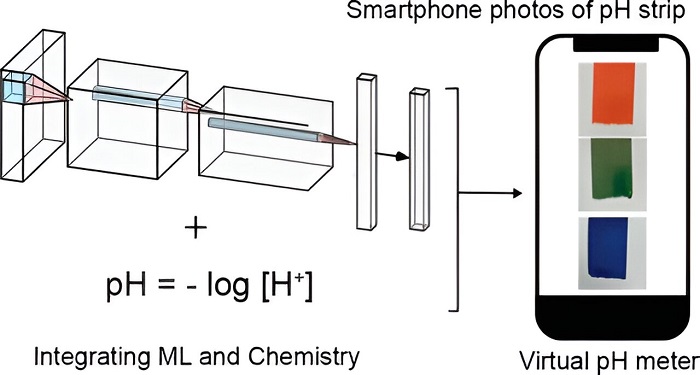 Source: Journal of Chemical Education (2023). DOI: 10.1021/acs.jchemed.3c00589
Participants used cellphone cameras to take pictures of pH test strips exposed to a variety of common liquids and analyzed the apparent pH levels visually. The same visual prediction process was also applied to test strips provided with known pH levels.
The observed data was then entered into a visual programming software package, enabling the students to derive predictions from the test strip images and pH values. The Orange machine learning software improved accuracy as it learned to delineate subtle changes in test-strip color with the corresponding pH values. As reported in the Journal of Chemical Education, a subsequent comparison of machine learning pH level predictions with visual predictions demonstrated that the AI-generated results better reflected the true pH values.
“Students could see the relevance of cutting-edge technology when applied to real-world problems and scientific advancements,” said Shiyan Jiang, assistant professor of learning design and technology. “This practical application not only enhances their understanding of complex science concepts but also inspires them to explore innovative solutions, fostering a deeper appreciation for the intersection of cutting-edge technology and science, in particular chemistry.”