New Year's Eve ball drop engineering
Ryan Clancy | December 28, 2023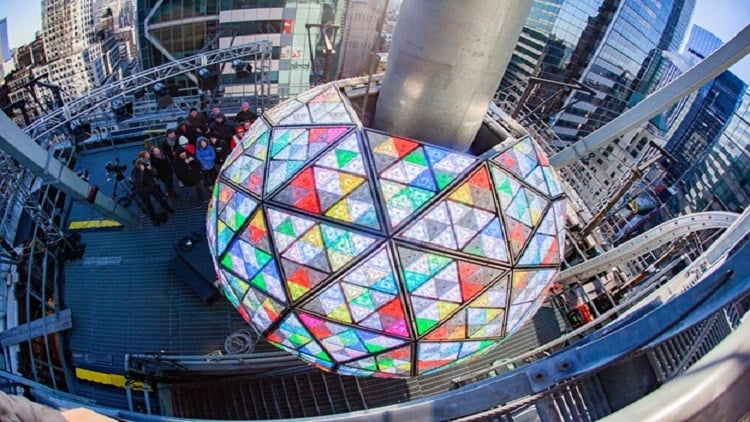 Source: Anthony Quintano via Flickr/CC BY 2.02
It’s apt that the end of the year should go out on such a dazzling spectacle. It never fizzles out and never fails to captivate the slightly tipsy New York crowds as they celebrate the arrival of the New Year.
The iconic ball drop has been a fixture of Times Square’s year end celebrations for over a century. It has become synonymous with the countdown to midnight on New Year's Eve. Out above the city streets, in full view of thousands, the ball of light slowly descends. Anticipation builds, and the crowd starts their own countdown. They erupt at the last tick of the clock, and the words of Auld Lang Syne are taken up by everyone in the sprawling crowd.
Revelers don’t even have to be in midtown Manhattan to watch the massive ball of mirrors and electric lights drop as the last seconds of midnight slip away. This is a worldwide phenomenon, one that rivals any fireworks show in any of the major cities around the globe. New Yorkers would say that there’s nothing quite like it, and the millions of folks who tune in on their televisions from afar would probably agree, but what makes this electrified moment possible? Exactly what feats of engineering go into the creation of this controlled descent and the circuitry that inhabits that big geodesic sphere of LED lights?
An engineer’s perspective on a New Year’s Eve spectacle
Cutting through the razzle-dazzle of the night, engineers know that the creation of the Times Square New Year's Eve Ball Drop involves a complex engineering process. The massive lattice of mirrors requires careful design and construction techniques to ensure its stability and functionality. They work to ensure that the intricate circuitry powering the lights is synchronized against whatever clock rules the event, thus making the display conclude on the very last second of the old year as it runs out.
To those on the street and all around the globe, it’s a ballet of synchronized movement and dazzling lights, but to those working behind the scenes, it’s a meticulously controlled operation that’s made possible by planning and programming. Today, computers oversee the split-second timing. They start the drop and use motorized control circuits to adjust the speed of the plummet, braking the drop as the last few ticks of the clock are cued up in microprocessor memory. Every light pattern on the LED illuminated ball, every effect, and algorithmically braked ball subsystem, they’re all programmed in as a smaller part of an orchestrated whole. Again, that’s what happens now, but computers weren’t around a century ago, which begs the question: how did the timing of the New Year’s Eve ball drop work back in the late 1800s?
Tracing back the legacy of the Times Square ball drop
The very first ball drop is described in some detail on the Times Square official website. On it, readers can see how the event began in 1907 and how “time balls” became something of a tradition for a few years. Back in New York, the city was undergoing a transformation. The first subway was about to open, and a German immigrant by the name of Adolph Ochs, owner of the New York Times, was petitioning the city for something special.
The lobbying would see converging avenues renamed. This was the birth of Times Square into the billboard-laden beating heart of the Big Apple. As important as this historical context is, this isn’t a historical piece. So, what about the cornerstone of this celebration? Well, it was timed to coincide with New Year’s Eve. The first ball drop was made of heavy iron and wood, and there were only 100 old-fashioned light bulbs built into its 700 lb frame. The inaugural ball made its maiden descent manually on sets of ropes, probably held in the hands of burly New Yorkers.
Time passed, marked by more drops of the original ball. Electric motors and pulley systems replaced the manual drop mechanism, the New Yorker muscle. At only 5 feet in diameter, it wasn’t too hard to maneuver. Still, 700 lbs, that’s a lot of illuminated bulk to synchronize. Fortunately, over the years, the design and materials of the ball have evolved, culminating in the current dazzling Waterford Crystal ball, which is significantly larger, with a diameter of 12 feet. From iron and wood to aluminum, then to a geodesic sphere made of crystal lattice work and LED lights, the current system is sophisticated to the point that it mirrors the city’s own transformation into a bustling metropolis.
Ball drop craftsmanship and technological innovation
At last count, 32,000 LED lights cover a 12,000 lb geodesic ball that’s 12 feet in diameter. That’s a far cry from the original ball, as commissioned by Mr. Ochs. Each Waterford crystal panel had to be cut precisely and assembled with meticulous care. Cutouts are required to incorporate the thousands upon thousands of LEDs, each one assigned with a digital address so that effects can be input en masse to the entire lighting framework. Jacob Starr, the engineer behind that first iron and wood globe, would be astonished by the level of engineering required to integrate all of these subsystems. Like the city’s most advanced elevator system, high-tensile cables and a guiding shaft made from a vertically inclined framework of rigid metal alloys direct the ball drop on its controlled descent. Computers monitor this fall, auditing the descent against a digitally set clock.
As computer control is in the driver's seat, built-in parallelism is guaranteed. The software goes to work, and confetti machines go off as the last second of the year runs out, and the 2,600 panels of Waterford crystal work in tandem with the Philips-designed lighting system. A huge clock displays those last ticks and tocks, and a fireworks system receives a signal to celebrate the moment. As for the crowd below, and all around the world, they don’t need any electrical systems or lighting effect algorithms to tell them to celebrate the New Year!