
Passive cooling promotes solar panel performance
S. Himmelstein | January 24, 2024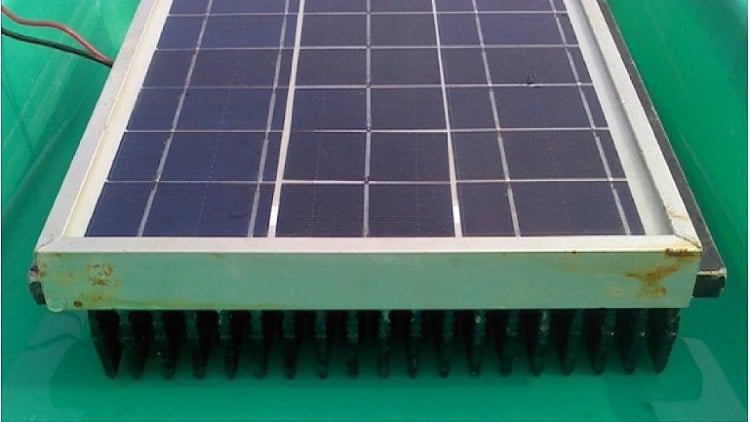 Photovoltaic panel with heat sink fins immersed in water layer. Source: Applied Energy, CC BY 4.0 DEED
The elevated operating temperatures of photovoltaic panels degrades and shortens the lifespan of solar energy equipment. An effective passive cooling design to remedy this thermal threat has been demonstrated by researchers from the University of Queensland (Australia), University of California Los Angeles and Thiagarajar College of Engineering (India).
Cooling is provided by combining heat-absorbing phase change material incorporating calcium chloride and cesium tin chloride, packed to a thickness of about 0.02 m, with aluminum-based heat sink fins. The 5 W polycrystalline panels under test were placed in a container filled with 3.3 l of water to accelerate the transfer of heat to the heats sinks via energy storage and evaporation.
Field experiments conducted in southern India documented a daily energy output about 9% greater than that of a reference panel. The maximum power obtained from the cooled panel was 20.25% higher than that of a reference panel. The novel system described in Applied Energy helped reduce the panel temperature by 10.14° C. When scaled up to a 1 MW plant, the drop in temperature indicated a lifetime extension from 25 years to 31 years.
Th photovoltaic cooling architecture also offers a 9.4% increase in carbon dioxide reduction compared to a conventional solar panel, and an estimated energy savings potential of 366.5 MW per year for large scale photovoltaic systems.



