Milestone for hydrogen-boron fusion power
S. Himmelstein | April 11, 2023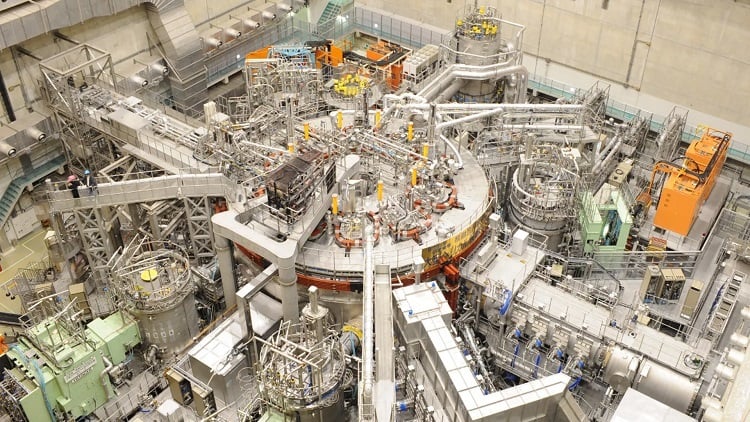 The LHD – a massive superconducting stellarator. Source: NIFS
California-based TAE Technologies reports completion of the first-ever hydrogen-boron (p11B) fusion experiments to produce a sustainable fuel for utility-scale fusion power.
Most fusion research efforts focus on combining hydrogen isotopes deuterium-tritium (D-T) to use as fuel in tokamaks. TAE engineers instead have focused on hydrogen-boron as an abundant, environmentally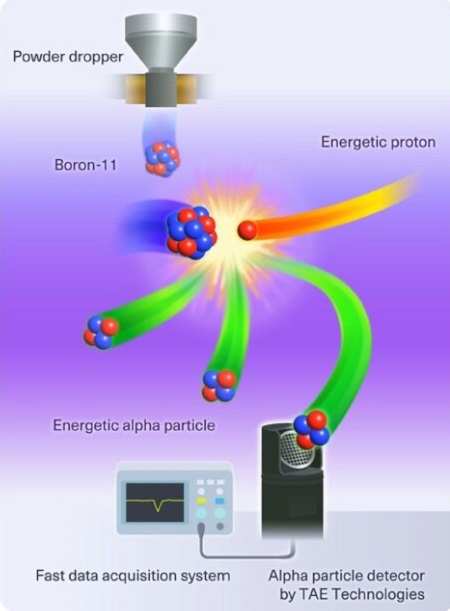 In the experimental setup, boron is dropped into the plasma from the powder dropper and fuses with energetic protons injected with high-energy neutral beams. The resulting alpha particle is registered by the alpha particle detector. Source: NIFS found fusion fuel that yields only helium as a reaction byproduct.
In a collaboration with Japan’s National Institute for Fusion Science (NIFS), the experiments were conducted in a magnetically confined fusion plasma contained in the Large Helical Device (LHD) at Japan’s National Institute for Fusion Science, with whom TAE Technologies collaborated. The research published in Nature Communications describes the conditions required to support p11B fusion in the LHD plasma and TAE’s development of a detector to measure the helium nuclei, or alpha particles, released.
While this reaction did not produce net energy, it demonstrates the viability of aneutronic fusion — characterized by the release of energy in the form of charged particles — and of p11B as a fuel. In pursuit of this clean, economical path to producing power, the company is advancing a compact linear reactor design with an advanced accelerator beam-driven field-reversed configuration (FRC). The system is engineered to accommodate all available fusion fuel cycles, including p11B, D-T and deuterium-helium-3.
Relative to tokamaks and other fusion power designs, the FRC reactor offers ease of maintenance, a compact footprint, and more efficient magnetic confinement that will yield up to 100 times more power out. TAE expects to demonstrate net energy on its next research reactor around mid-decade in preparation for connecting the first p11B fusion power plant to the grid in the 2030s.